

What You Gained by Reading Last Week’s Market Mornings and What You Missed If You Didn’t!
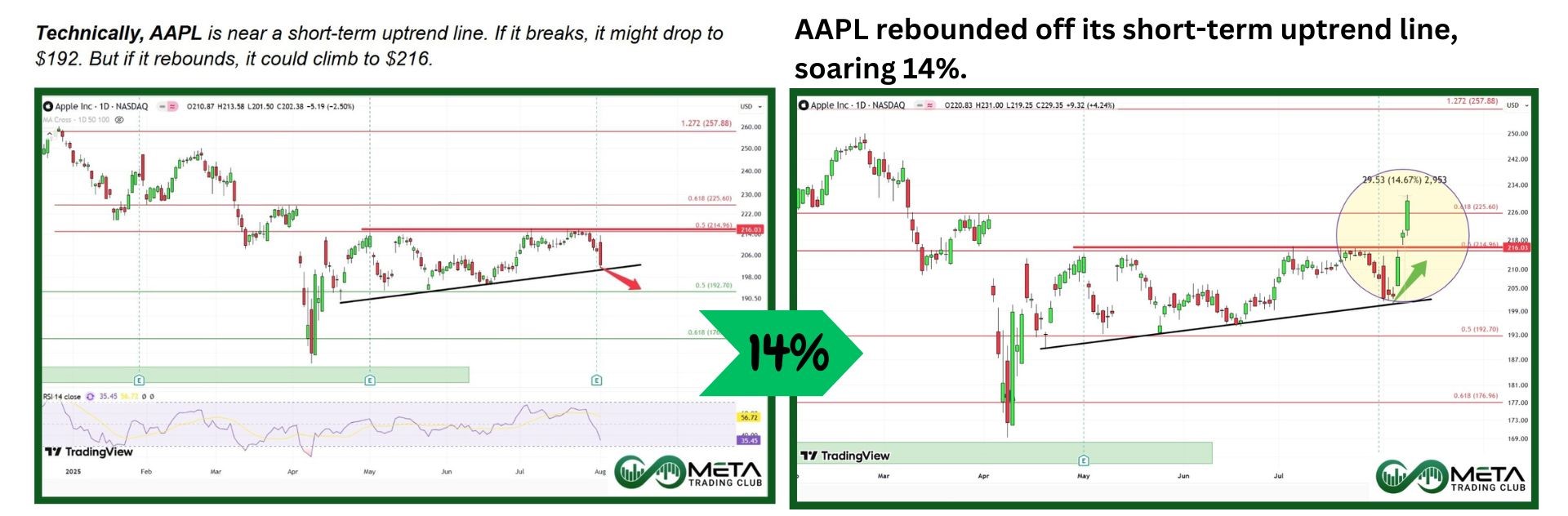

Last Week’s report
Economic Reports
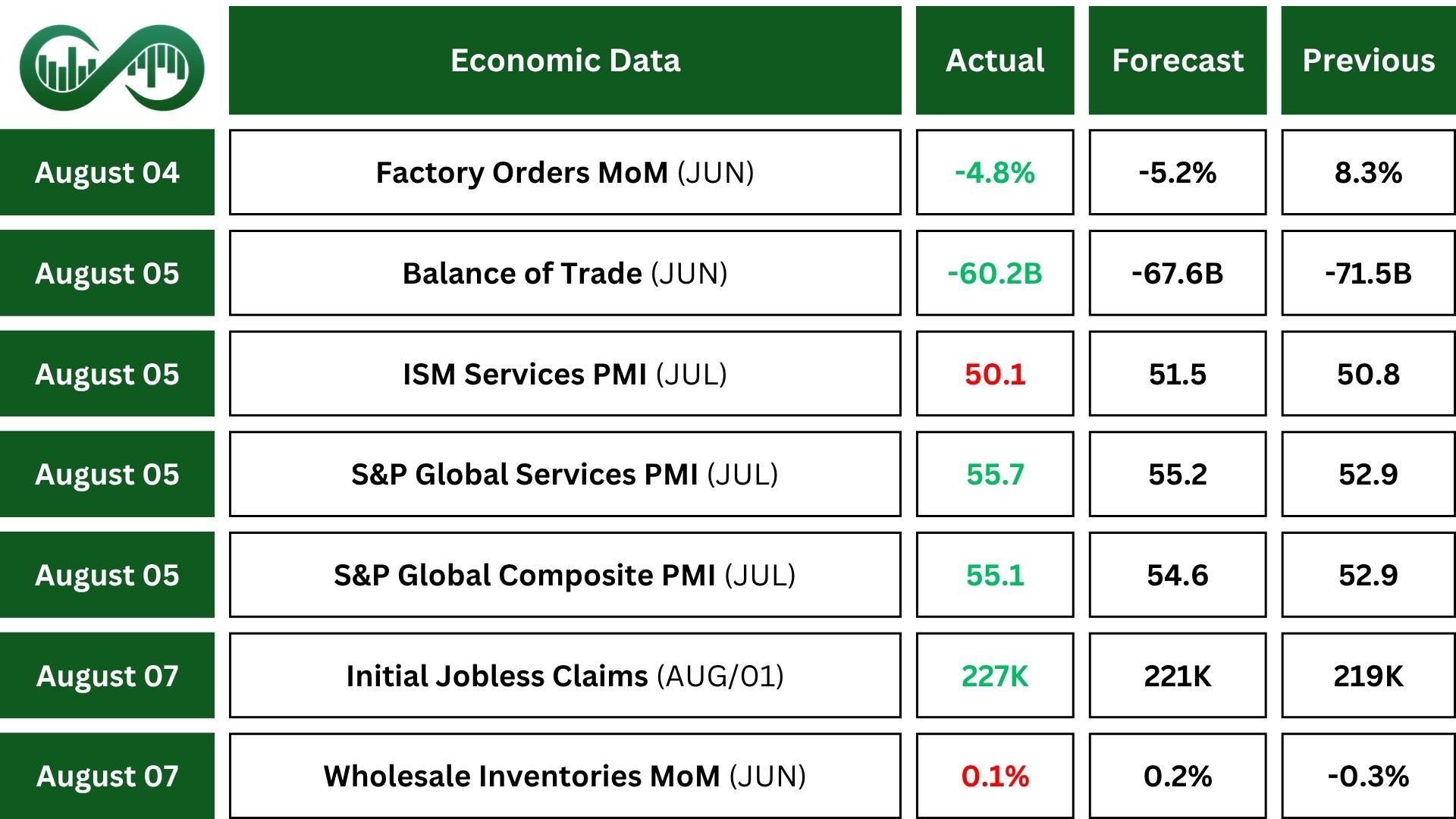
In July, U.S. service sector activity slowed sharply, with the ISM Services PMI dropping to 50.1, just barely above contraction. Business production, new orders, and inventories all weakened due to seasonal challenges. Prices rose to their highest level since late 2022, driven mostly by tariff-related pressures on commodities. Employment continued to decline, stayed in contraction territory, and supply deliveries lagged. Exports and imports also contracted, indicating that global trade is being affected by tariff frictions. This signals that economic momentum in the services sector is weakening, raising concerns about broader slowdown risks.
The initial jobless claims rose to 226,000 higher than expected. Continuing claims, which reflect ongoing unemployment, jumped to nearly 2 million, the highest since November 2021. This suggests that more people are struggling to find new jobs after being laid off. Although initial claims are still lower than early June levels, the overall trend points to a cooling job market.
In June, U.S. wholesale inventories rose slightly by 0.1% to $906.3 billion, recovering from a 0.3% drop in May. Compared to the previous year, inventories were up 1.3%, though this was a bit lower than earlier estimates. This signals a cautious rebound in inventory levels, suggesting wholesalers are adjusting stock gradually amid uncertain demand
In June, the U.S. trade deficit dropped sharply, the lowest since September 2023, better than expected. This was mainly due to a 3.7% fall in imports. Exports also dipped slightly by 0.5%, led by declines in metal shapes. The trade gap with Mexico, China, and the EU narrowed, while deficits with Vietnam, Taiwan, and India grew. This signals a cooling in global trade activity, likely influenced by shifting demand and tariff-related pressures.
Earnings Reports

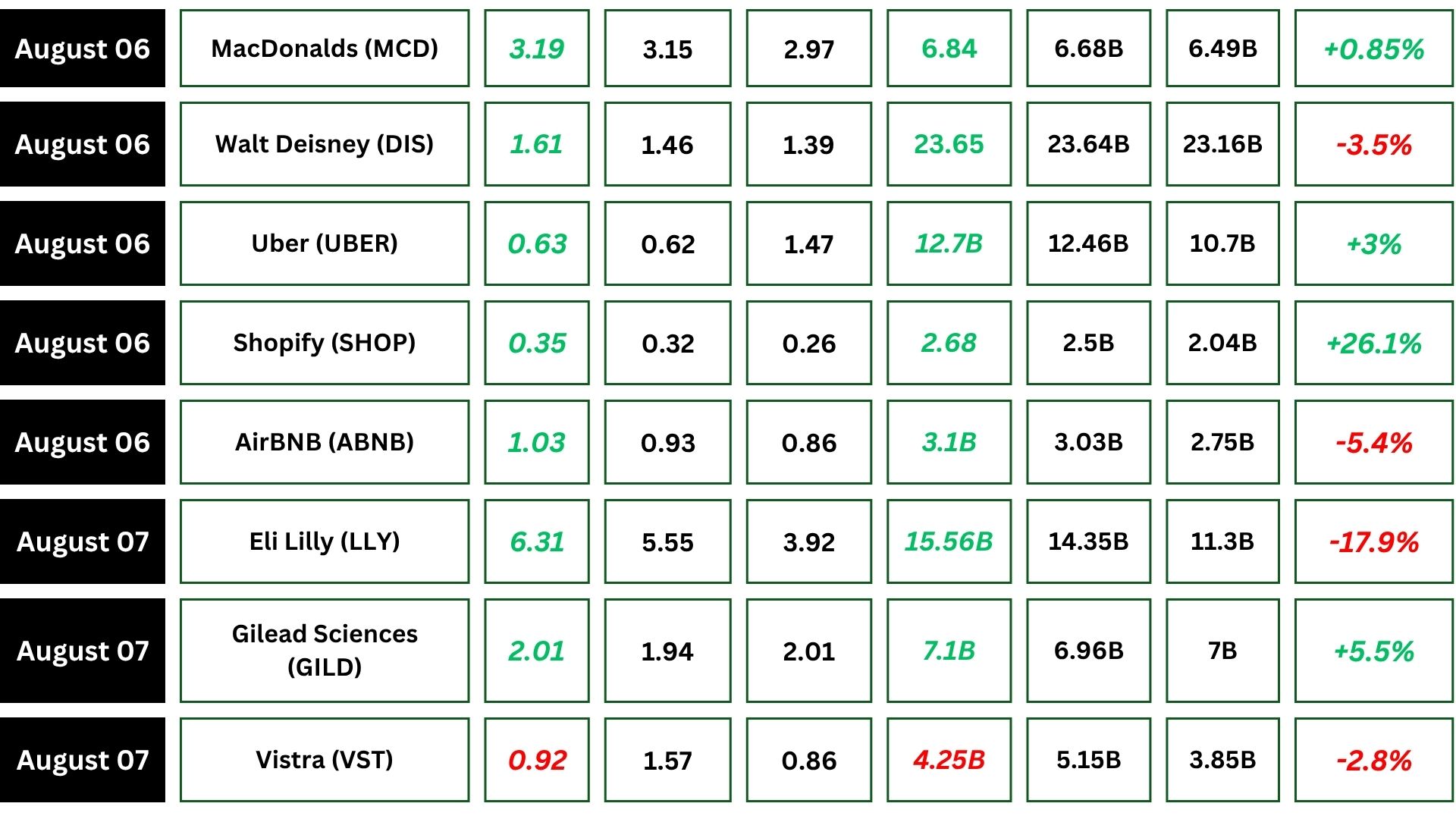
Palantir
Palantir Technologies (PLTR) delivered a record-breaking Q2 2025. The company surpassed $1 billion in quarterly revenue for the first time, a 48% year-over-year increase.
U.S. commercial revenue soared 93%, while government revenue rose 53%. Also, the company closed 157 major deals and posted adjusted EPS of $0.16, beating expectations.
Palantir raised its full-year revenue forecast to over $4.14 billion and expects Q3 revenue to grow 50% year-over-year. Fueled by strong AI demand and expanding federal contracts, its stock surged 21%, hitting a new all-time high.
Advance Micro Devices
Advanced Micro Devices (AMD) posted record Q2 2025 revenue of $7.7 billion, driven by strong demand for its EPYC server chips and Ryzen desktop processors.
However, earnings per share fell short at $0.48 due to $800 million in charges tied to U.S. export restrictions on its MI308 AI chips.
Despite regulatory headwinds, AMD launched new AI products, expanded partnerships with major tech firms, and forecasted higher Q3 revenue.
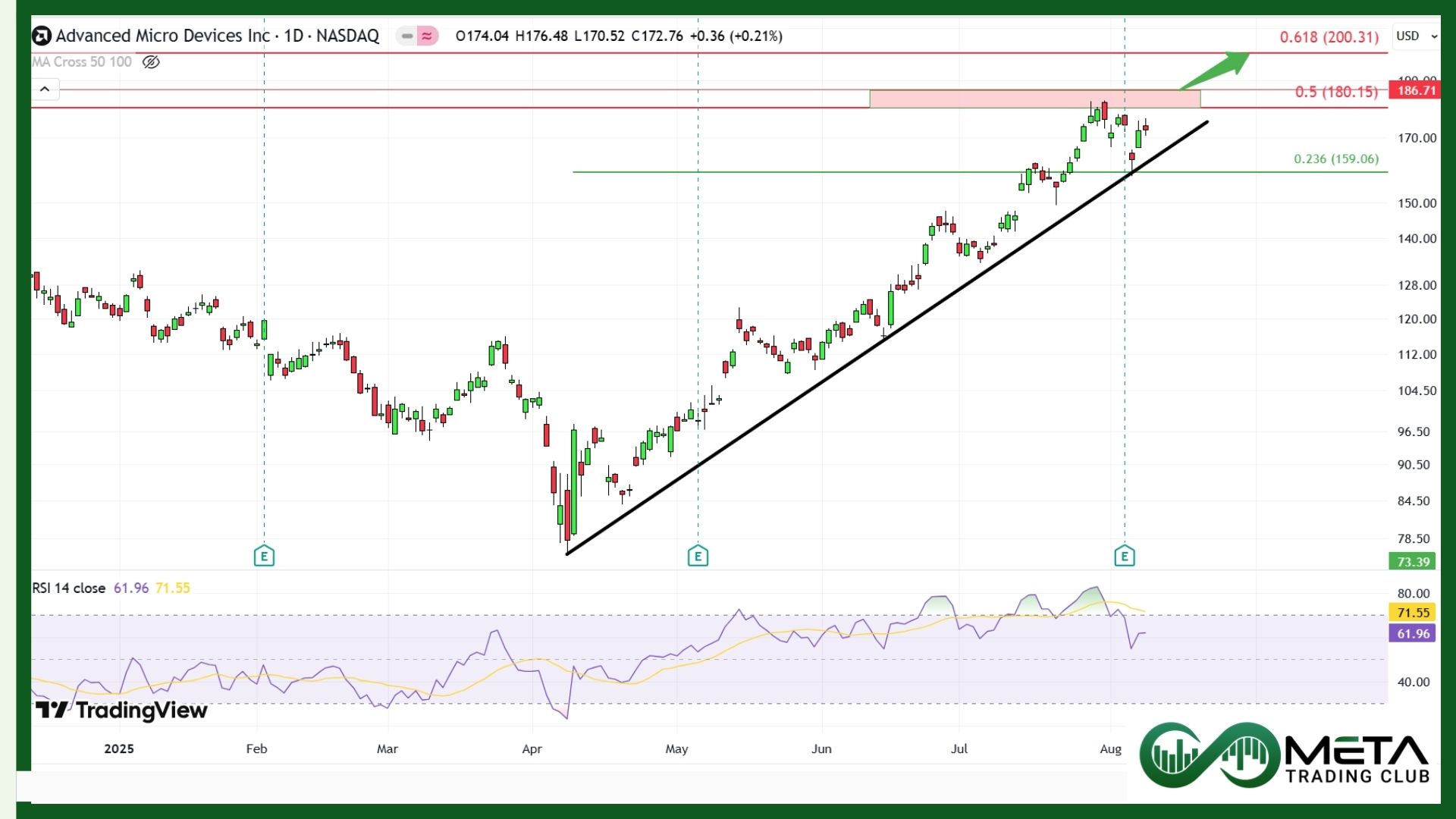
Technically, if AMD breaks through the $180 resistance zone and establishes confirmation above it, the stock could rally toward the $200 resistance level. However, a rejection at $180 may trigger a downward move.
Arista Networks
Arista Networks (ANET) delivered a strong Q2 2025, with revenue rising 30% year-over-year to $2.205 billion and earnings beating expectations.
Profitability remained high, with gross margins above 65% and non-GAAP net income reaching $923.5 million.
The company launched new AI-powered networking products, expanded its global reach through the acquisition of Broadcom’s SD-WAN portfolio, and boosted manufacturing in India.
Its stock jumped over 18% after the report, driven by strong results and a positive outlook for Q3.
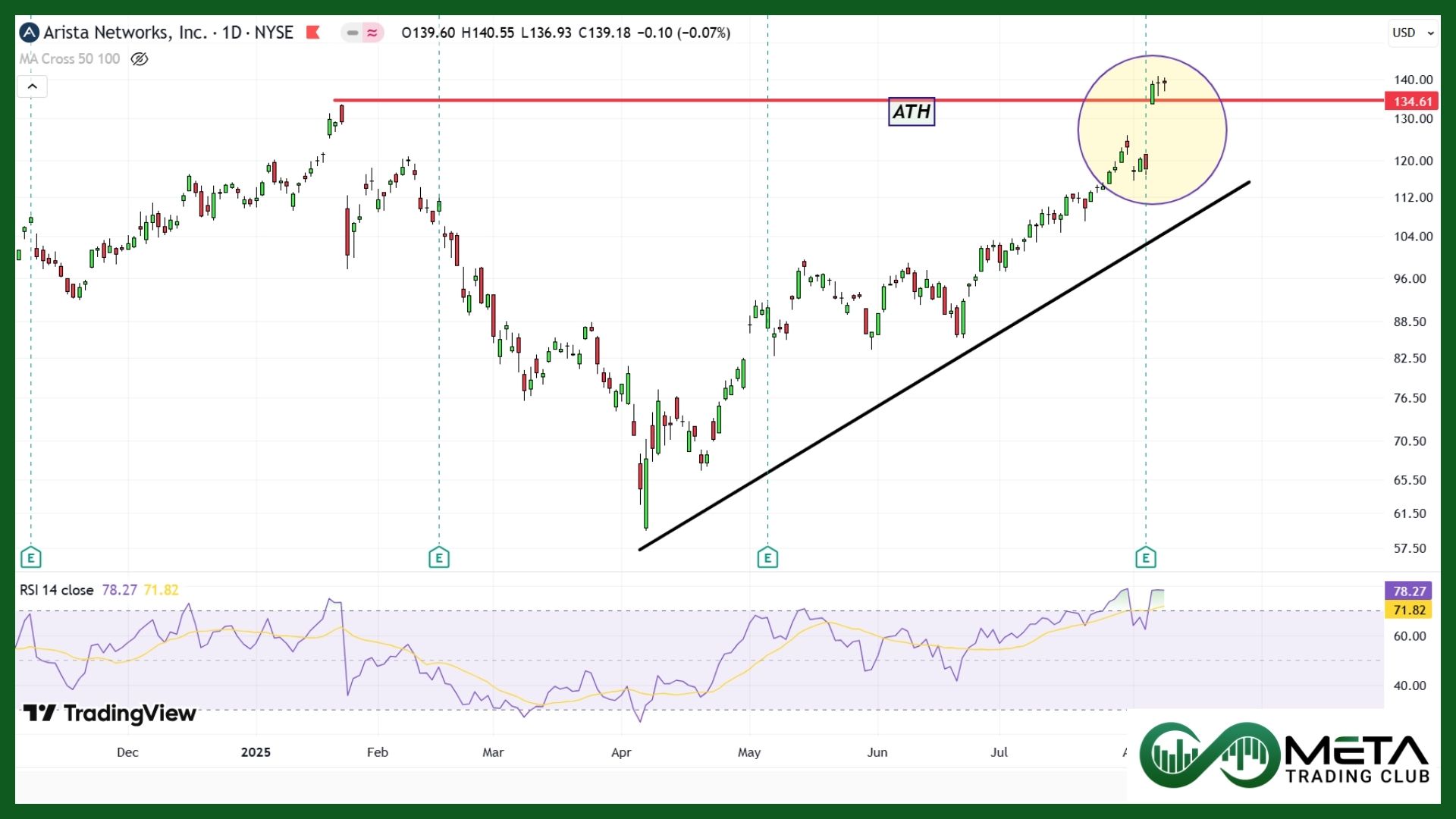
Technically, ANET has recently broken its previous all-time high and continues to surge higher if $135 support holds.
Shopify
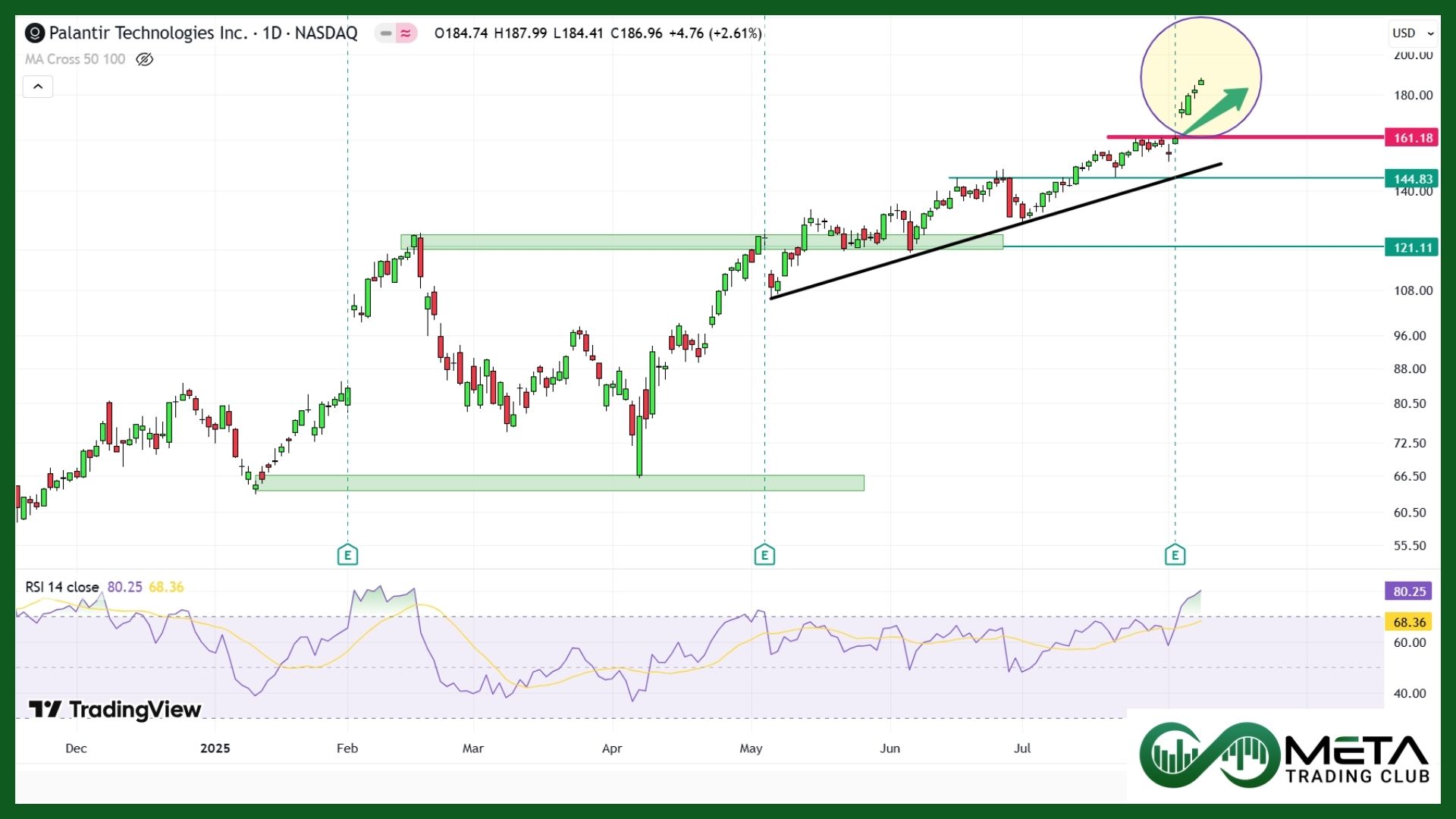
Shopify (SHOP) delivered a strong second-quarter performance in 2025, with revenue rising 31% year-over-year to $2.68 billion and free cash flow margin holding at 16% for the eighth straight quarter.
Earnings per share came in at $0.69, more than double expectations. The company also issued a solid revenue forecast for Q3, projecting $2.76 billion, about 4.6% above market estimates.
Growth was driven by increased merchant activity across North America, Europe, and Asia Pacific, with Europe showing standout performance.
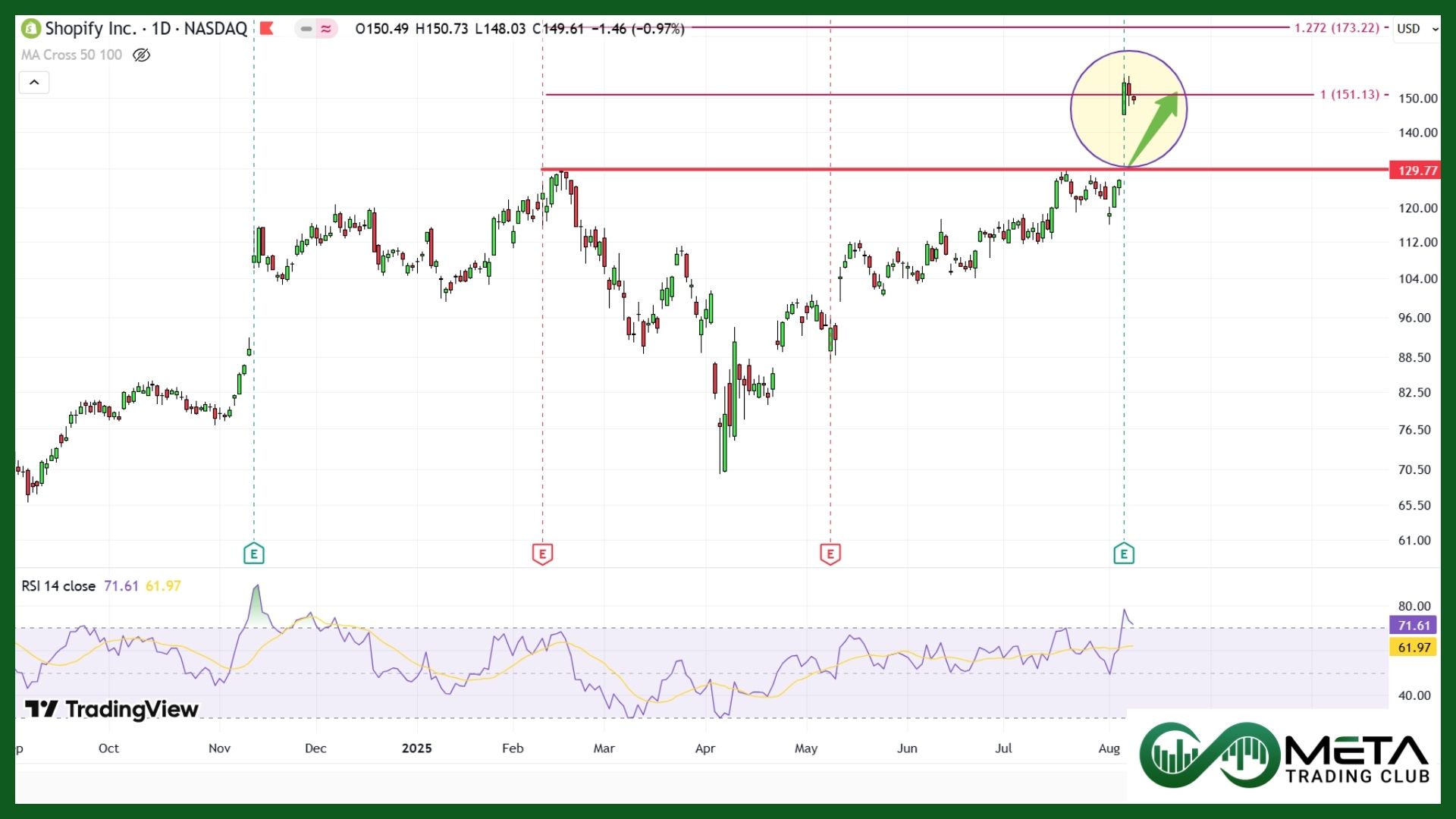
Technically, SHOP broke through its previous all-time high resistance at $129, then surged 26% to reach the Fibonacci resistance zone at $151, where a potential pullback could occur.
Uber
Uber (UBER) reported solid second-quarter results for 2025, with trips and gross bookings both rising 18% year-over-year.
Revenue reached $12.7 billion, and operating income surged 82% to $1.5 billion.
The company also announced a major $20 billion share buyback program, reflecting confidence in its financial strength.
For the next quarter, Uber expects bookings to grow up to 21%, though its forecast came in slightly below market expectations.
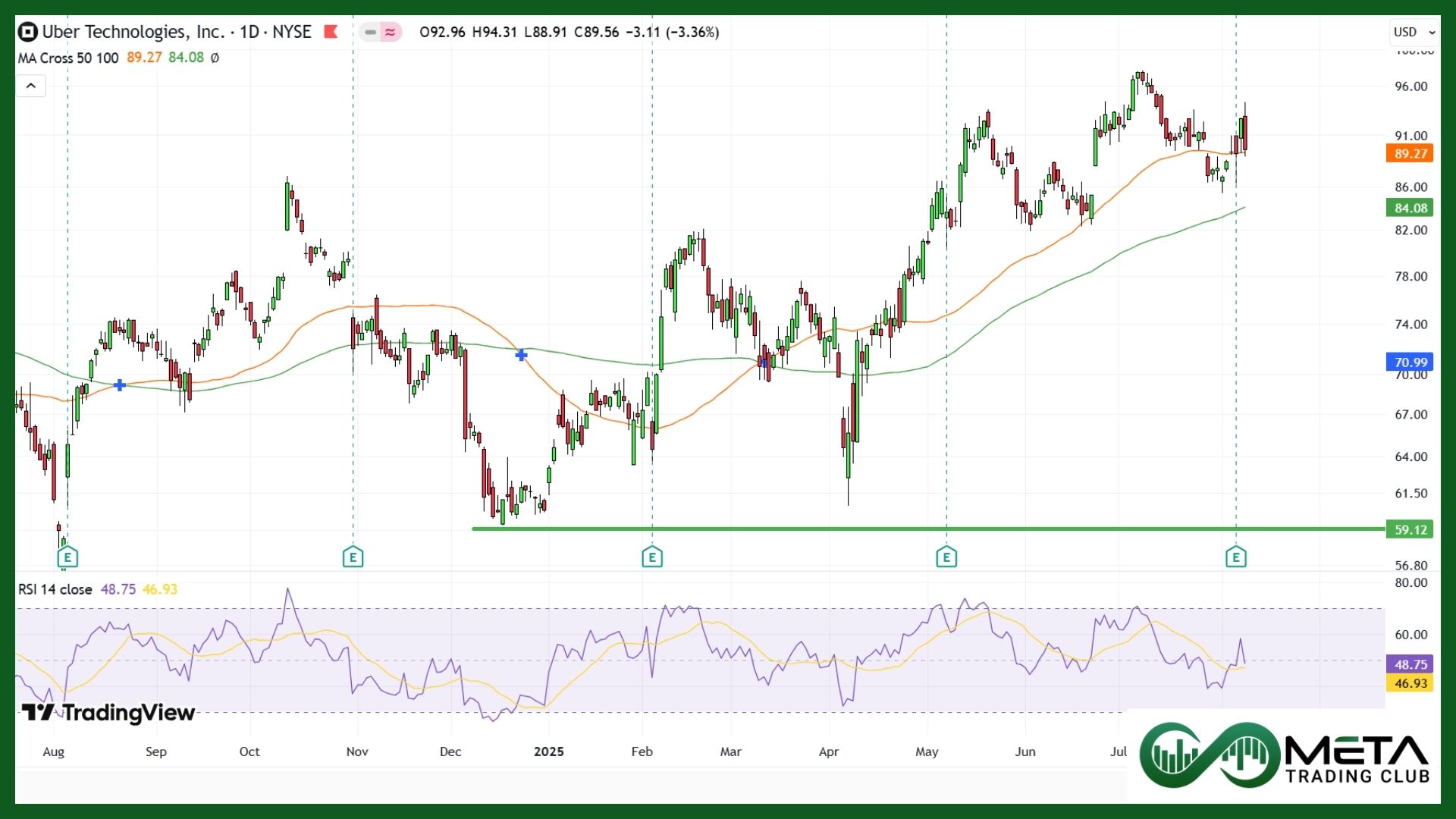
Despite the solid performance, Uber’s stock dipped due to cautious guidance and concerns over currency headwinds.
Indices
Indices’ Weekly Performance:
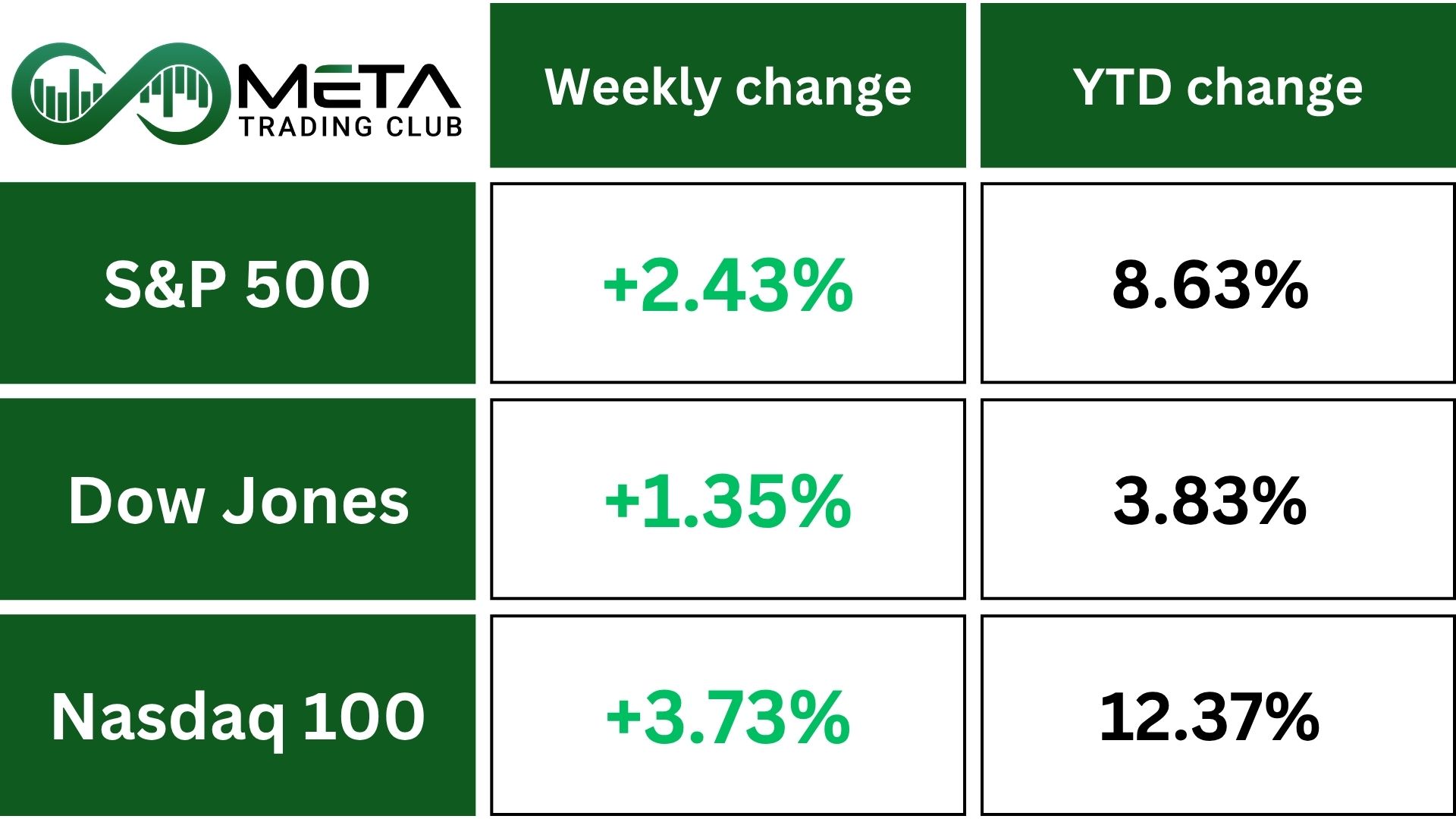
Stocks moved up last week filled with tariff news but little market drama, keeping all three major U.S. indexes positive.
Even with President Trump’s new import taxes taking effect, Wall Street stayed upbeat. Strong corporate earnings and ongoing talks for product-specific tariff exemptions, like the recent one for Apple, helped boost investor confidence.
US stocks finished higher last week. Over the week, the S&P 500 increased by 2.4%, the Dow by 1.4%, and the Nasdaq by 3.9%.
The tech sector led the gains, especially Apple, which jumped after announcing a $600 billion investment plan in the U.S.
Meanwhile, investors were also encouraged by hopes of interest rate cuts after Trump nominated Stephen Miran to the Federal Reserve Board. This hints at possible changes in monetary policy. This came despite concerns over new tariffs on imports from several countries.
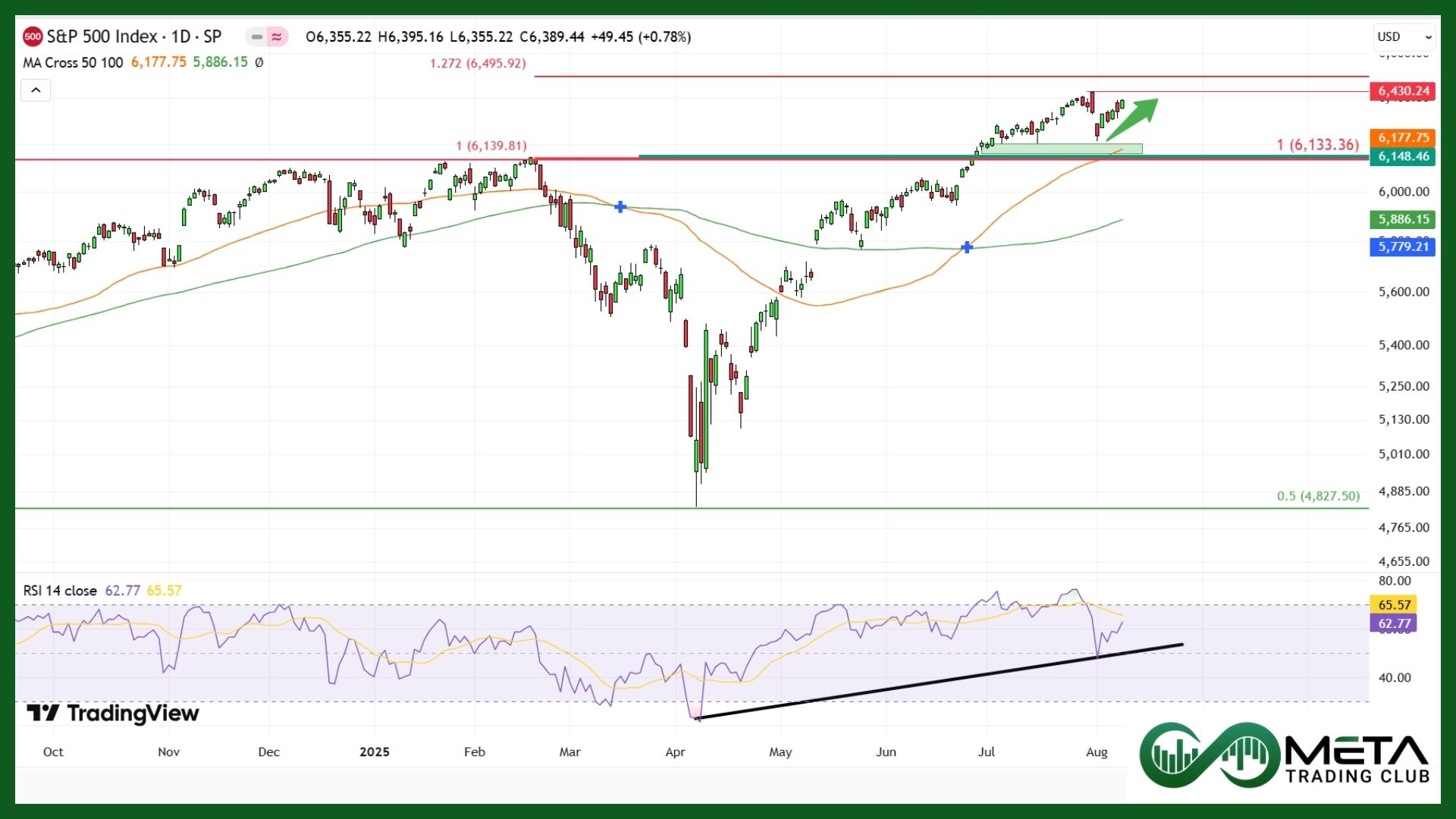
Technically, SPX rebounded from a strong support zone and climbed as anticipated last week. If the index breaks through the 6400 level, it could rally toward 6500, aligning with a key Fibonacci resistance zone.
Stocks
Sector’s Weekly Performance:
Most market sectors moved higher, with Basic Materials Technology and Consumer Discretionary leading the way, while Energy, Healthcare, and Real Estate struggled.
- Technology rose sharply, with the sector up 3.8%. Palantir jumped over 20% after raising its revenue forecast again due to strong AI demand. Apple surged more than 13% after announcing a $100 billion manufacturing plan in the U.S., which helped ease concerns about tariffs. Semiconductor stocks also gained 2.7%.
- Communication Services gained 3.6%. Walt Disney beat earnings expectations and raised its forecast due to streaming growth. However, its stock still ended the week down more than 3%.
- Consumer Discretionary climbed 3.1%, fueled by McDonald’s outperforming expectations thanks to its budget-friendly menu items.
- Industrials edged up 0.4%. Axon Enterprise, maker of TASER devices, soared to a record high after a strong Q2 report and a raised outlook for 2025, posting a weekly gain of over 13%.
- Healthcare declined 0.16%. Eli Lilly dropped around 18% for the week after disappointing data from its oral weight-loss drug. Vertex Pharmaceuticals also sank about 21% following a setback for one of its pain treatments.
Top Performers
Last week saw remarkable stock market performance, with several companies standing out as top gainers:
- Shopify (SHOP): Surged 26% due to strong Q2 earnings with 31% revenue growth and EPS beat.
- IDEXX Laboratories (IDXX): Advanced 23% on better-than-expected earnings, driven by growth in veterinary diagnostics and international expansion.
- Palantir Technologies (PLTR): Gained +21% due to 48% revenue growth and raised full-year guidance.
- Applovin Corporation (APP): Soared 20% from rallied on record revenue from its AI-powered Ad platform.
- Arista Networks (ANET): Rose 18% as delivered 30% YoY revenue growth and record operating income.
- Axon Enterprise (AXON): Up 13% after a strong Q2 report and a raised outlook for 2025.
- Micron Technology (MU): Gained 13% on AI-driven demand for memory chips and signs of recovery in DRAM/NAND markets. Analysts upgraded the stock amid improving margin outlook.
- Apple (AAPL): Climbed 13% after announcing a $100 billion manufacturing plan in the U.S., which helped ease concerns about tariffs.
Commodity
Weekly Performance of Gold, Silver, WTI and Brent Oil:
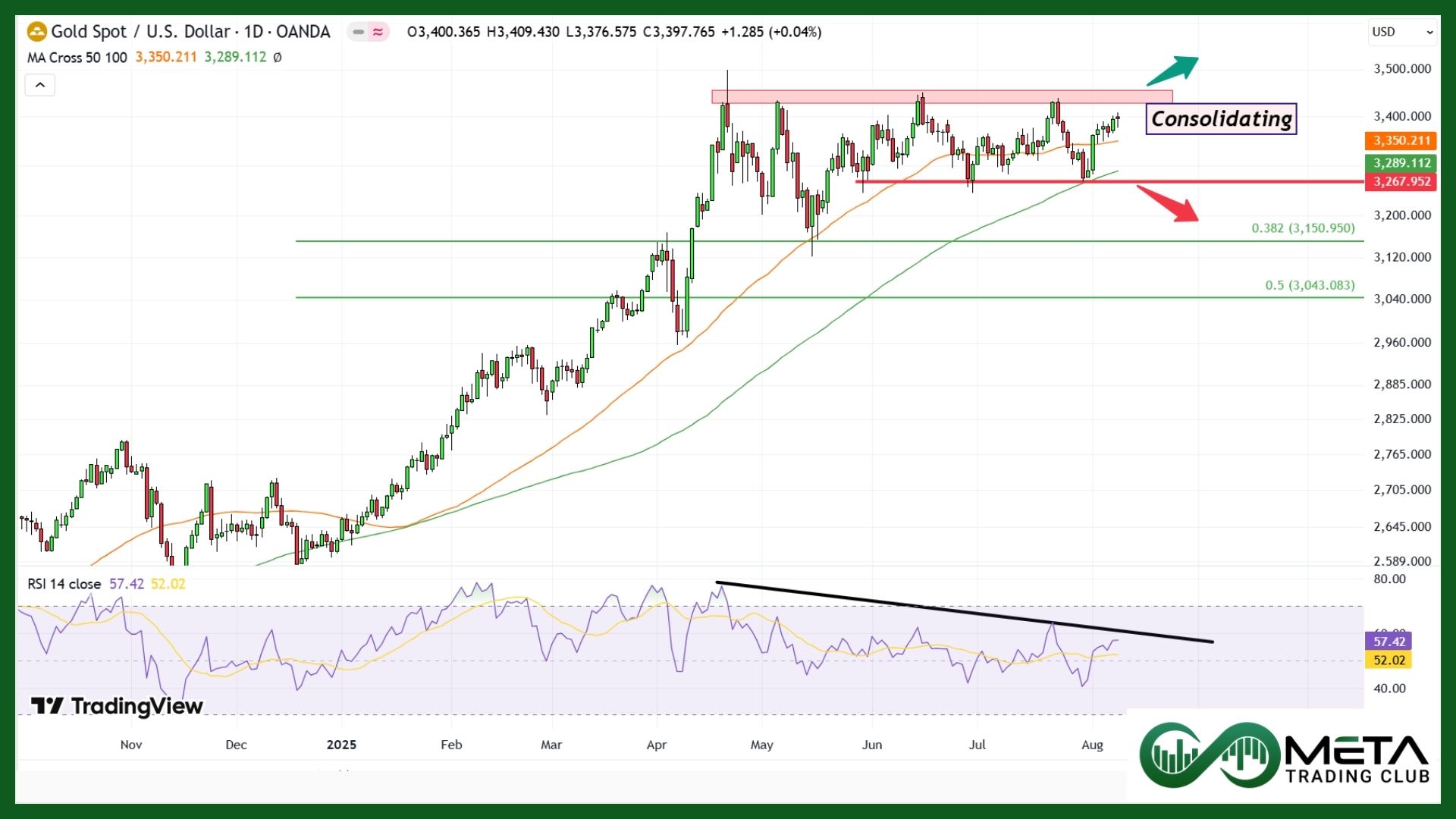
Gold (XAU/USD) rose nearly 1%, its second weekly gain in a row. The increase was driven by growing concerns over trade, fresh tariff announcements, and rising hopes for interest rate cuts from the Federal Reserve.
The Financial Times reported that US Customs has decided to tax one-kilo and 100-ounce gold bars, surprising the industry which had expected these would be exempt. This change could significantly affect Switzerland, a key gold-refining country, since gold is one of its top exports to the US.
Technically, Gold has been consolidating in a range between $3,240 and $3,440 for some time. It bounced off its 100-day moving average, showing renewed buying interest. For the next clear trend to emerge, gold needs to either break above $3,440 resistance or below $3,240 support. Until then, price action may remain sideways
WTI Crude Oil ended the week down over 5%, near a two-month low. The drop was driven by concerns over new U.S. tariffs, which raised fears of slower global growth and weaker oil demand.
Talks of a possible Trump-Putin summit brought some hope for easing tensions around the Ukraine conflict, potentially lifting sanctions and boosting Russia’s markets. Uncertainty also lingers over potential secondary sanctions targeting Russia’s energy trade partners, such as China and India, adding pressure to the oil market outlook.
Forex
Weekly Performance of Major Foreign Exchange Pairs:
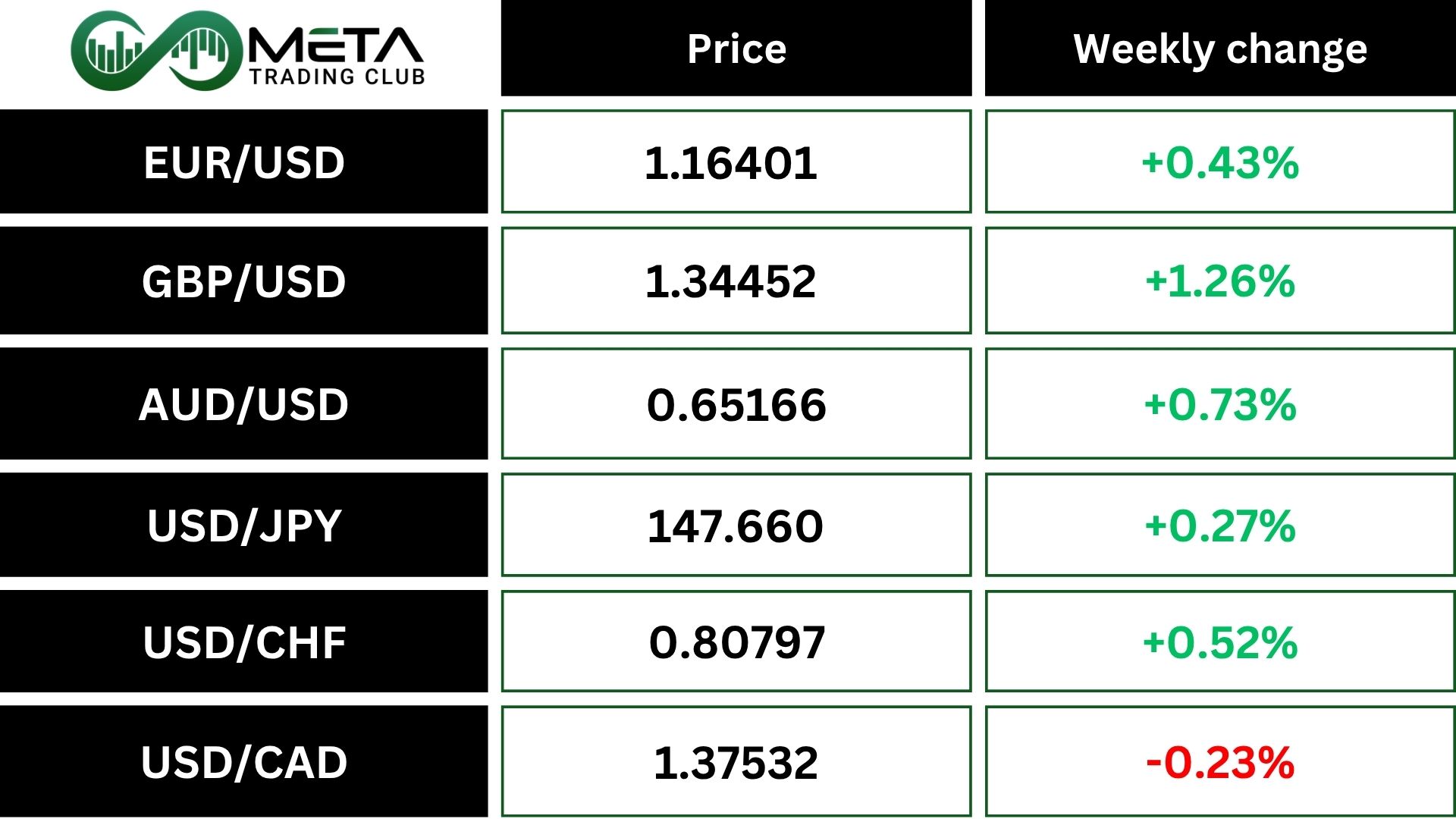
The U.S. dollar (DXY) headed for a 0.5% weekly decline. Weak economic data, disappointing job growth, a slowing housing market, and soft services sector performance, has led traders to expect more interest rate cuts from the Federal Reserve this year.
Also, President Trump plans to nominate Stephen Miran to a temporary Federal Reserve seat, while Fed Governor Christopher Waller is seen as a top contender to replace Jerome Powell as Chair.
These moves suggest a shift toward more aggressive rate cuts, with markets pricing in an 89% chance of a cut in September and 58 basis points in total cuts by year-end. Trump also fired a senior Labor Department official after weak job data, raising concerns about political influence on economic reporting.
The dollar rose against the yen, as the Bank of Japan’s July meeting revealed internal debate over the possibility of resuming rate hikes.
Sterling edged up following the Bank of England’s decision to cut interest rates, but only after a narrow 5–4 vote.
Crypto
Crypto Market Weekly Performance:
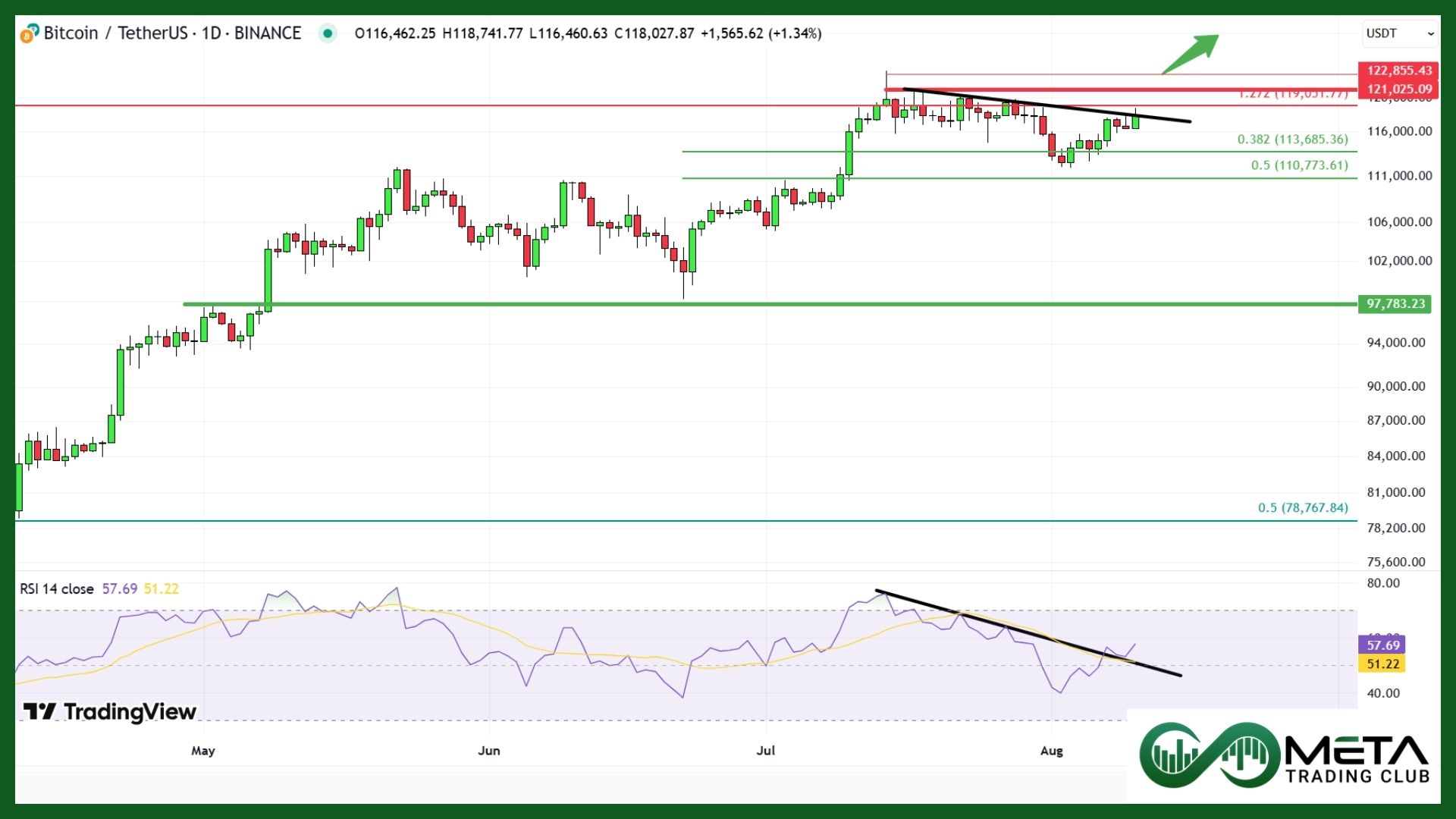
Bitcoin recently climbed to near $120,000 but has since settled around $118,000. Despite this rebound, its market dominance dropped to 58% as many altcoins outperformed.
Earlier in August, global tensions and political uncertainty triggered a sharp decline, pushing BTC below $112,000. However, strong buying support prevented further losses and helped fuel the recovery.
Technically, if Bitcoin closes clearly above $118,000, it could move up to test the $122,000 resistance level, possibly leading to new record highs. But if it falls below $115,000, the next key support to watch is the 100-day moving average near $109,000.
Next Week’s Outlook
Economic Events
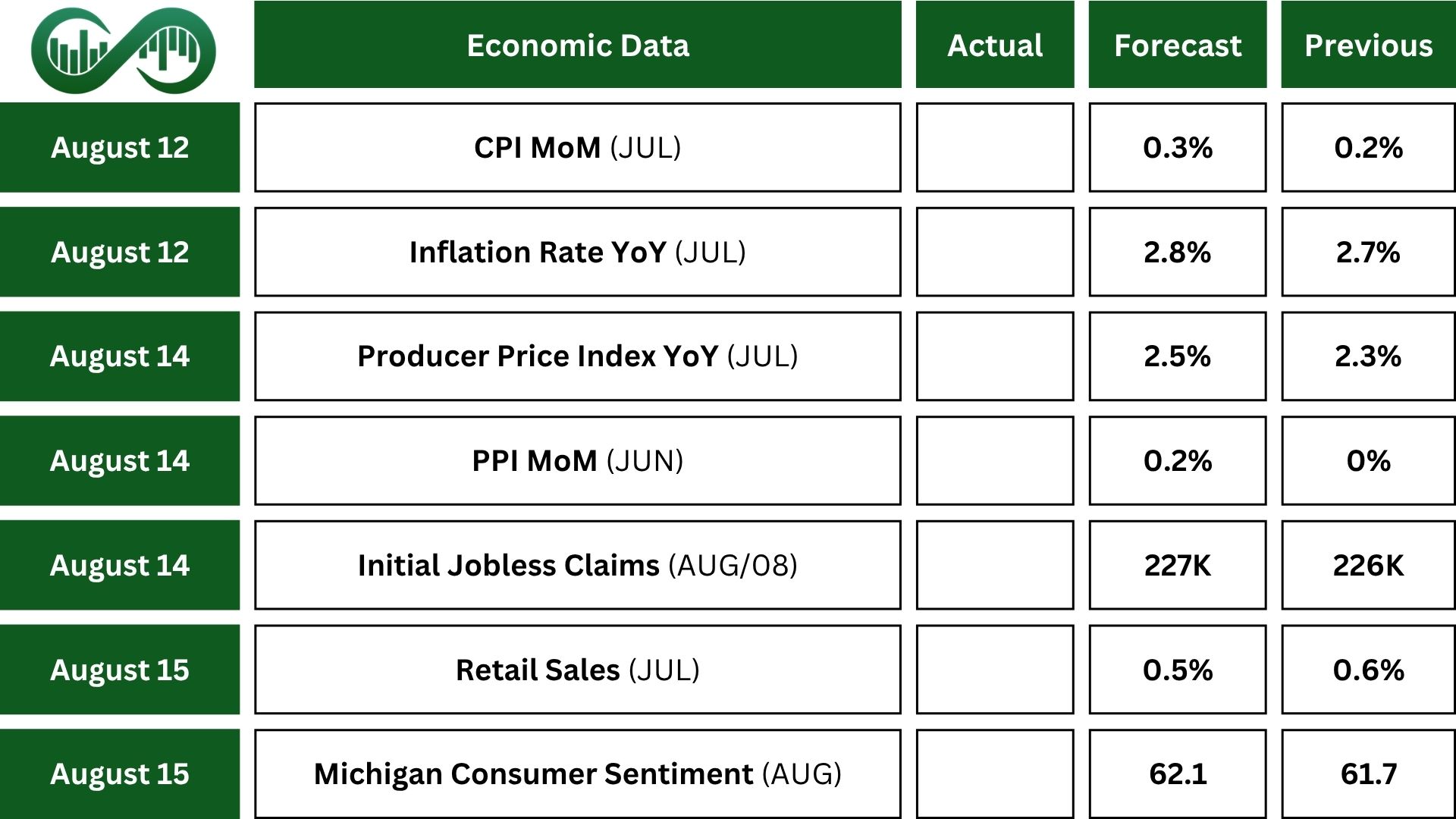
In the US, all eyes are on July’s Consumer Price Index (CPI) report, which could show how new tariffs are affecting inflation. Headline inflation is expected to reach 2.8%, the highest in five months, while core CPI might rise to 3%, also a five-month high.
Up next is the Producer Price Index (PPI), with both headline and core readings forecasted to increase by 0.2% month-on-month, after staying flat in June.
Retail sales expected to grow by 0.5%, slightly below June’s strong 0.6% gain, while industrial production may have dropped by 0.2%.
Consumer confidence, as measured by the University of Michigan’s index, is predicted to improve.
Other reports to watch include import and export prices, the monthly budget statement, the NFIB Small Business Optimism Index, the New York Empire State Manufacturing Index, and business inventories.
On the policy front, investors are following the confirmation process for Stephen Miran’s nomination to the Federal Reserve’s policy committee, along with comments from various Fed officials.
Earnings Events

As the second-quarter earnings season wraps up, investors are now turning their attention to upcoming reports from Cisco (CSCO), Applied Materials (AMAT), and Deere & Company (DE).