Gross Domestic Product (GDP) quantifies the total value of all goods and services produced within a nation’s borders. Therefore, it serves as a measure of economic activity. GDP can be computed using three approaches: production, income, and expenditure. Importantly, real GDP adjusts for inflation, providing a more accurate picture of growth. Governments, businesses, and economists utilize GDP to understand trends. Hence, it aids in making informed decisions.
GDP Adv Estimate Q4 2025
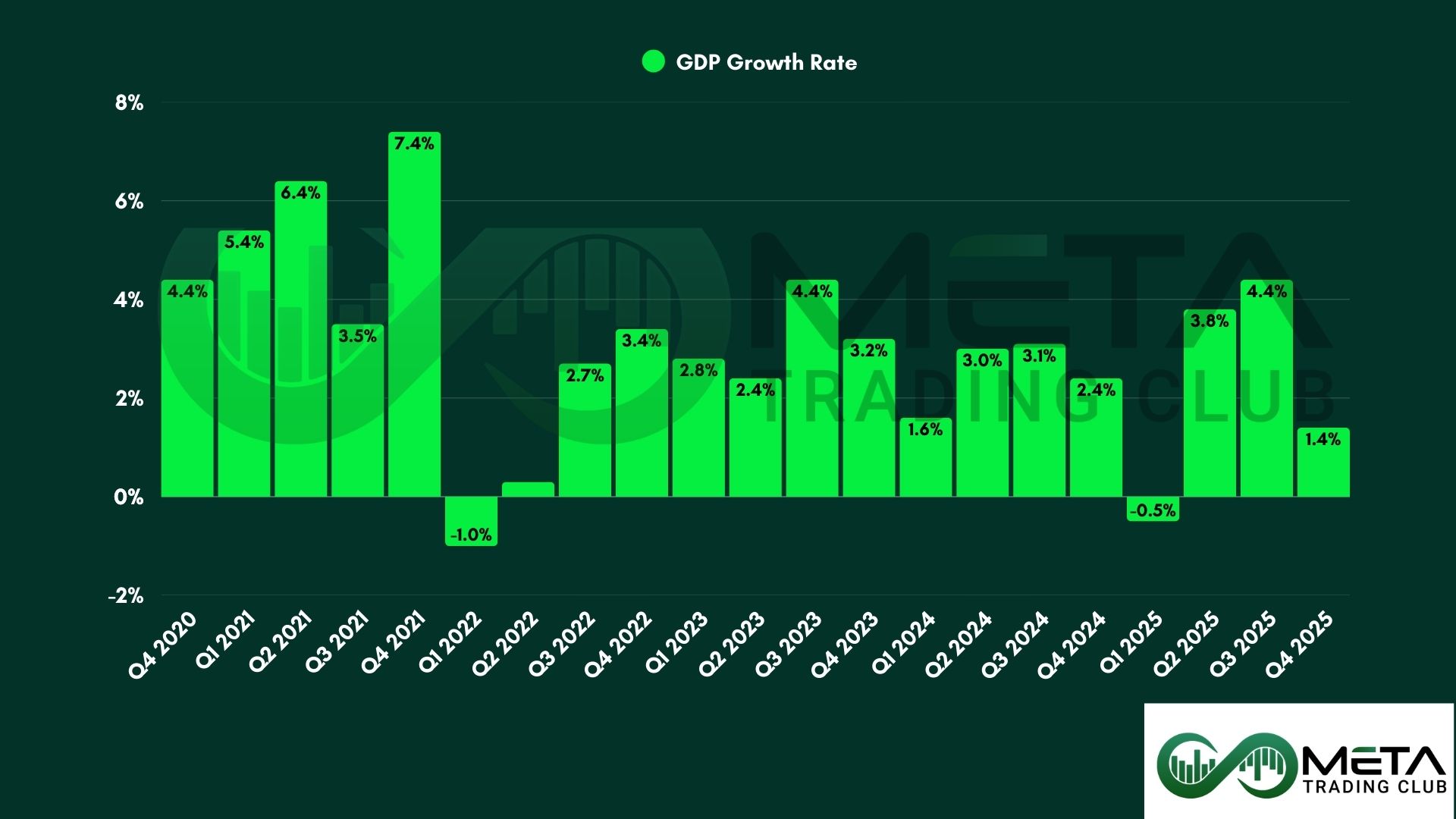
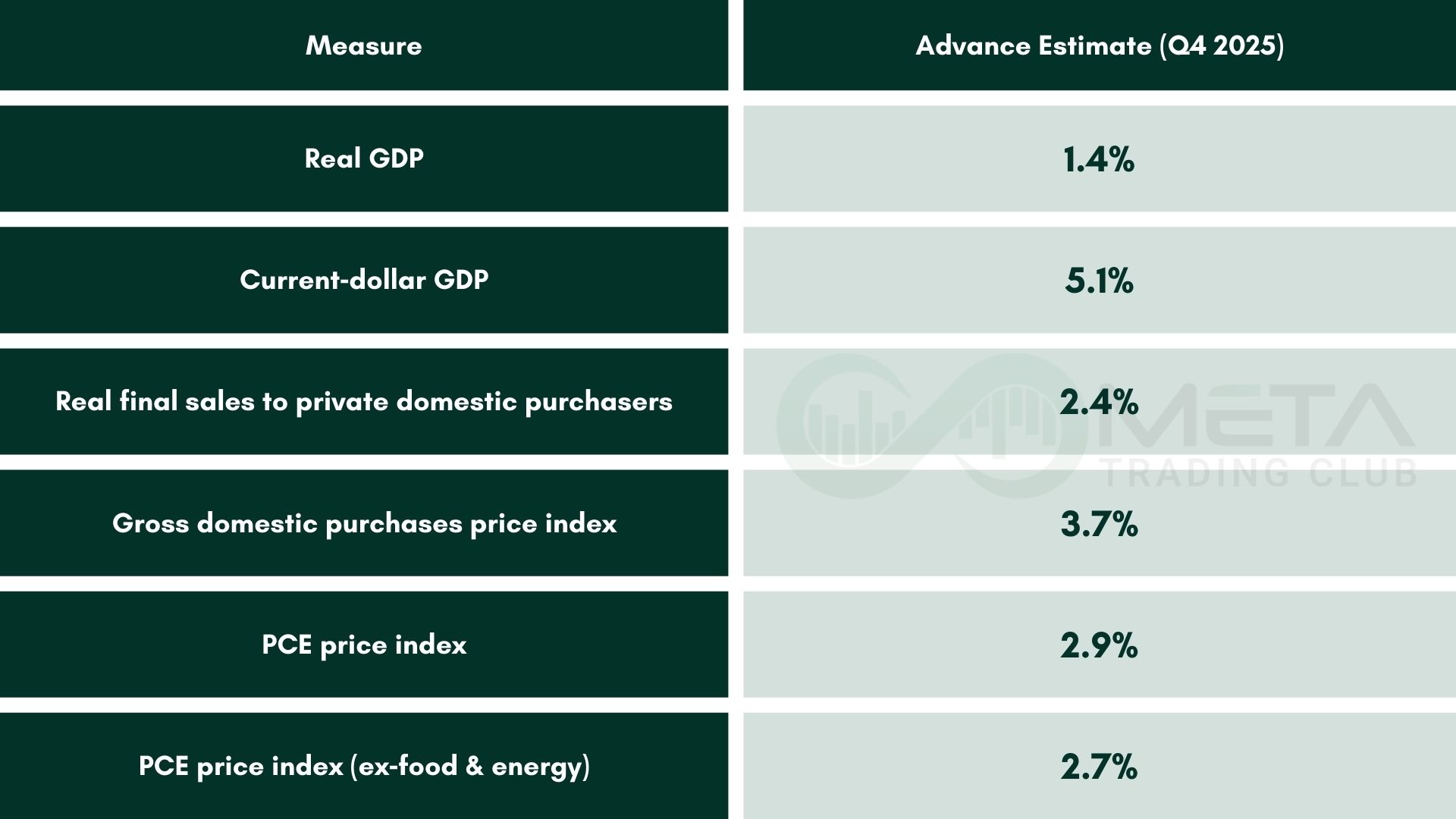
The U.S. economy expanded at an annual rate of 1.4% in the fourth quarter of 2025, according to the advance estimate from the Bureau of Economic Analysis (BEA). This marks a sharp slowdown from the 4.4% pace recorded in the third quarter.
Despite the deceleration, real GDP growth remained supported by consumer spending and investment, while declines in government spending and exports weighed on overall performance. Imports also fell, providing a small positive contribution since they subtract from GDP.
Key Drivers
Positive Contributors
- Consumer spending increased, led by services, especially health care and international travel.
- Investment strengthened, driven by:
- Intellectual property products (notably R&D)
- Private inventory accumulation in wholesale trade and manufacturing
- Equipment spending, particularly information processing equipment
Negative Contributors
- Government spending declined, reflecting reduced federal consumption expenditures during the shutdown period.
- Exports fell, including adjustments to remove investment‑related silver bar shipments from industrial exports.
- Imports decreased, though by less than in Q3.
The slowdown from the strong 4.4% growth in Q3 mainly came from lower government spending, weaker exports, and softer consumer spending. Imports also fell, but not as much as in the previous quarter. These drags were partly offset by stronger investment, which helped support overall growth.
Inflation Measures
Price pressures strengthened in Q4:
- The gross domestic purchases price index rose 3.7%, up from 3.4% in Q3.
- The PCE price index increased 2.9%, slightly above the prior quarter’s 2.8%.
- Core PCE rose 2.7%, compared with 2.9% previously.
Full‑Year 2025 GDP
For the year as a whole, real GDP grew 2.2%, down from 2.8% in 2024. Growth in 2025 was primarily driven by Consumer spending and Business investment.
Inflation for 2025:
- Gross domestic purchases price index: 2.6% (vs. 2.4% in 2024)
- PCE price index: 2.6% (unchanged from 2024)
- Core PCE: 2.8% (slightly below 2024’s 2.9%)
Impacts of the Report on the Stock Market
The GDP report weighed on the stock market by signaling weaker economic momentum and stubborn inflation. Slower growth in Q4, combined with hotter‑than‑expected PCE inflation, reduced hopes for easier Federal Reserve policy. As a result, major U.S. equity futures moved lower, with pressure especially visible in rate‑sensitive sectors, high‑valuation tech names, and banks. Investors reacted to the softer economic backdrop and the possibility that interest rates may stay higher for longer.