Gross Domestic Product (GDP) quantifies total value of all goods and services produced within a nation’s borders. Therefore, it serves as a measure of economic activity. GDP can be computed using three approaches: production, income, and expenditure. Importantly, real GDP adjusts for inflation, providing a true growth picture. Governments, businesses, and economists utilize GDP to understand trends. Hence, it aids in making informed decisions.
GDP Final Estimate Q2 2025
The U.S. Bureau of Economic Analysis (BEA) has released its third and final estimate for Gross Domestic Product (GDP) in the second quarter of 2025, covering the months of April through June. The data reveals a stronger-than-expected rebound in economic activity, driven by consumer spending and a sharp decline in imports. This report also includes revised figures for GDP by industry, corporate profits, and key price indexes.
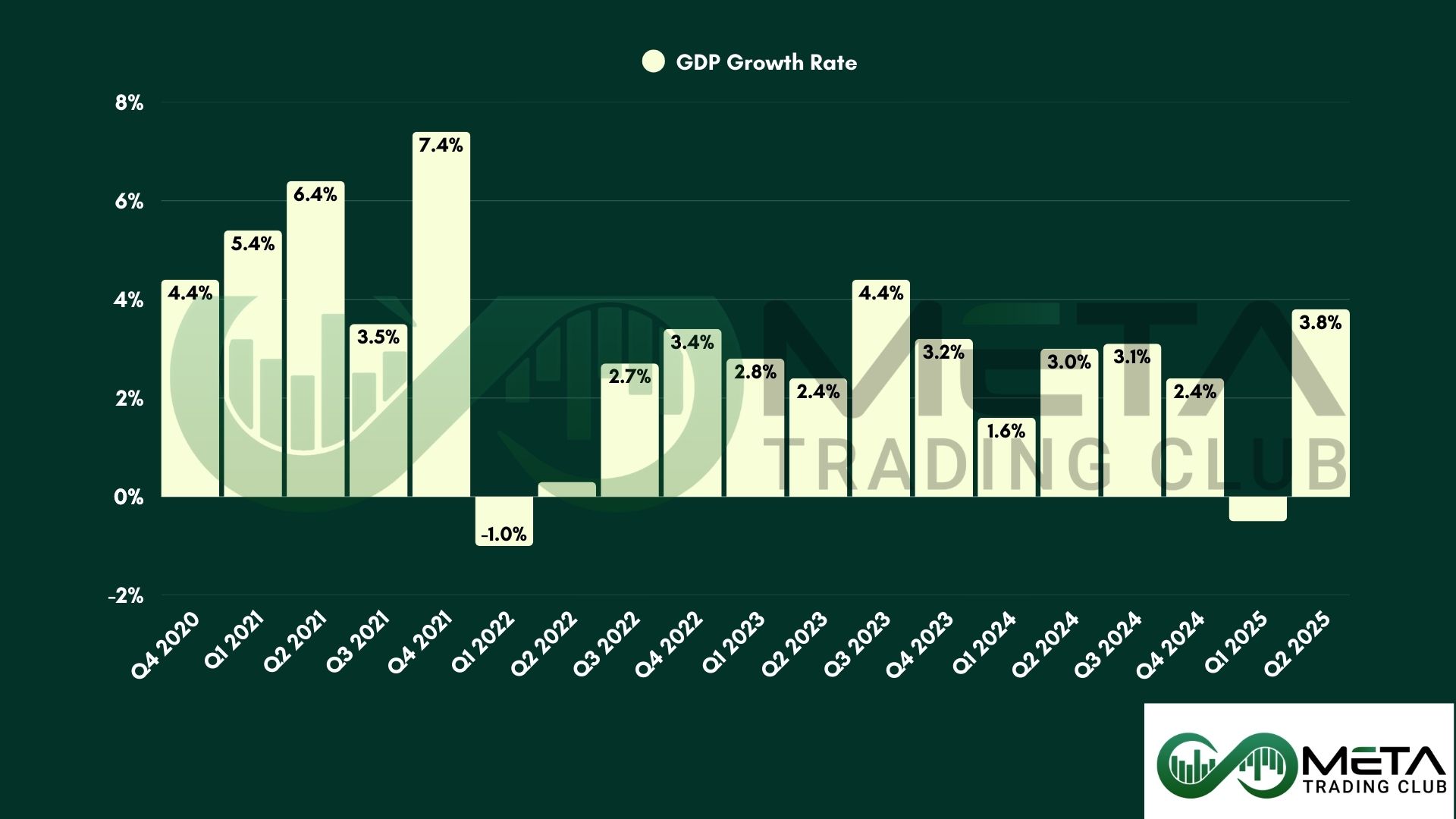
Real GDP Growth: Strongest Since Q3 2023
Real GDP increased at an annualized rate of 3.8% in Q2 2025, up from 3.3% in the second estimate and 3% in the advance estimate. This marks the strongest quarterly performance since Q3 2023 and a significant turnaround from the revised 0.6% contraction in Q1.

The upward revision of 0.5 percentage points was primarily due to stronger consumer spending than previously reported. Real final sales to private domestic purchasers, an important measure of underlying demand, rose 2.9%, revised up from 1.9%.
The Q2 GDP increase was largely driven by:
- A sharp downturn in imports, which are subtracted in GDP calculations.
- An acceleration in consumer spending, particularly in both goods and services.
- These gains were partially offset by declines in investment and exports.
Personal Consumption Expenditures (PCE)
Consumer spending was revised upward significantly:
- Overall PCE rose 2.5% (vs. 1.6% in the second estimate).
- Spending on goods increased 2.2%.
- Spending on services rose 2.6%.
This revision reflects stronger household demand and resilience in core consumption categories.
Goods and Services Lead Growth
From an industry perspective, real GDP growth was uneven across sectors:
- Private goods-producing industries saw a robust 10.2% increase in real value added.
- Private services-producing industries grew by 3.5%.
- Government output declined by 3.2%.
Gross output across all industries rose 1.2%, with:
- Goods-producing industries rose 0.6%.
- Services-producing industries up 1.7%.
- Government output down 0.7%.
These figures highlight the strength of private sector activity, especially in manufacturing and technology-related services.
Price Indexes: Inflation Remains Elevated
Inflationary pressures remained persistent in Q2:
- The price index for gross domestic purchases increased 2%, revised up 0.2 percentage points.
- The PCE price index rose 2.1%, revised up 0.1 percentage point.
- Core PCE (excluding food and energy) increased 2.6%, also revised up 0.1 percentage point.
These suggest that inflation remains above the Federal Reserve’s long-term target, even as growth accelerates.
Income Measures
Real Gross Domestic Income (GDI) increased 3.8% in Q2, revised down from 4.8% in the second estimate. The average of real GDP and GDI also came in at 3.8%, revised down 0.2 percentage point.
Corporate profits from current production increased by $6.8 billion in Q2. However, this represents a downward revision of $58.7 billion from earlier estimates, indicating weaker-than-expected earnings momentum.
Impacts of Report on the Stock Market
The stronger-than-expected 3.8% GDP growth in Q2 signals economic resilience, easing recession fears and boosting investor confidence. This supports a risk-on sentiment, with expectations of solid corporate earnings.
However, inflation remains elevated, PCE rose 2.1% and core PCE hit 2.6%, which may limit the Federal Reserve’s ability to cut rates further. Rate-sensitive sectors could face pressure.
Meanwhile, corporate profits rose modestly by $6.8 billion, but were revised down sharply, suggesting earning challenges. Investors may shift toward companies with strong pricing power and cost control.