The unemployment rate is a measure of the percentage of the total labor force that is unemployed but actively seeking employment and willing to work. It’s a key indicator of the health of the labor market and the economy. A 4.2% unemployment rate means that 4.2% of people able and willing to work do not currently have a job.
Nonfarm payrolls refer to the total number of paid workers in the U.S., excluding farm employees, government employees, private household employees, and employees of nonprofit organizations. This statistic is reported monthly by the U.S. Bureau of Labor Statistics and is a critical indicator of economic health. An increase in nonfarm payrolls typically signals economic growth and means more job creation.
Employment Situation – November 2025
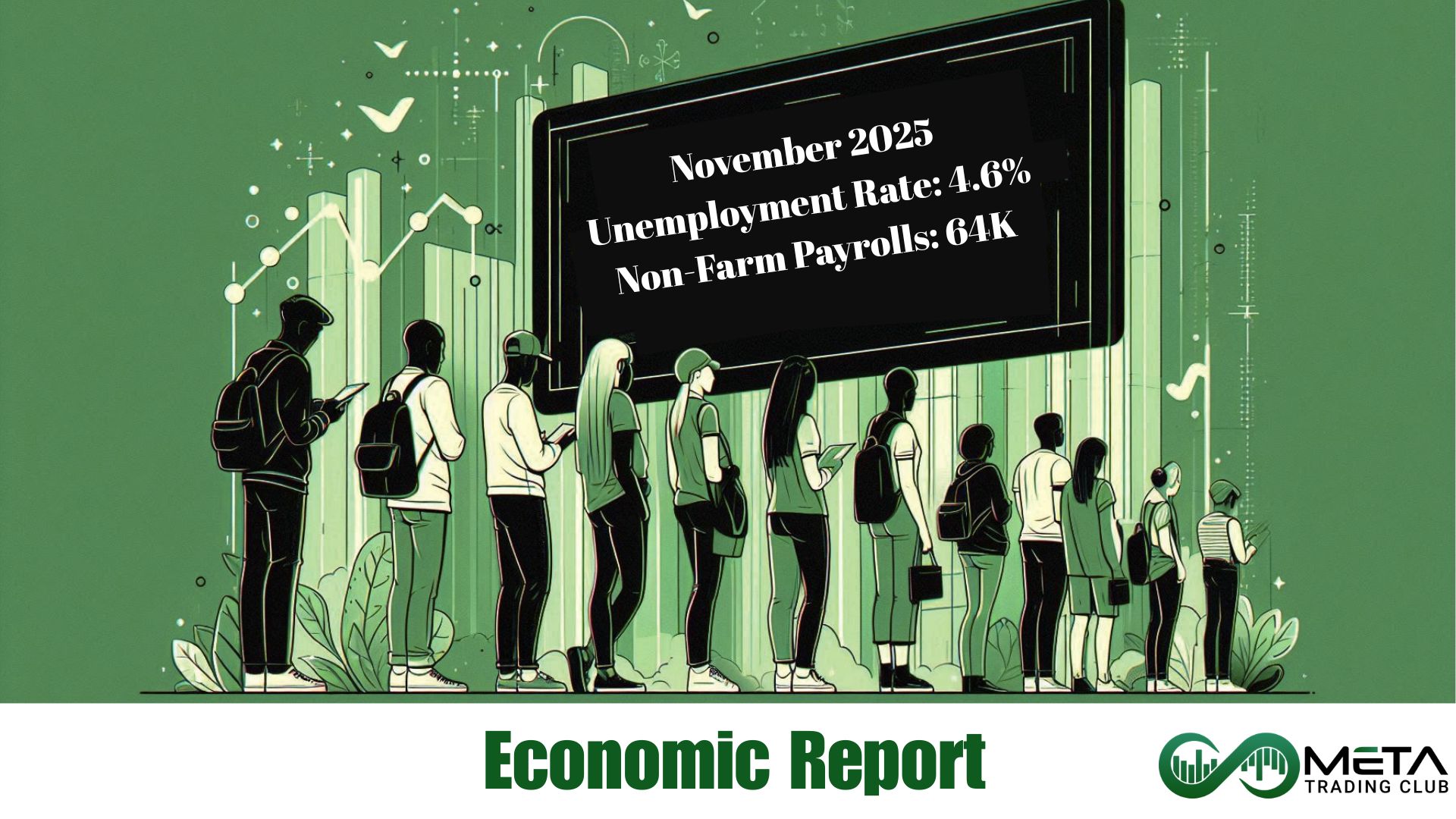
The U.S. unemployment rate rose to 4.6% in November, the highest since 2021 and above expectations. Payrolls grew by 64K, rebounding from October’s 105K loss and beating forecasts.
Labor Force Overview
The U.S. labor market’s November unemployment rate rose to 4.6% and the number of unemployed remained at 7.8 million, little changed from September.
Unemployment rates across major demographic groups were broadly stable, except for teenagers, whose jobless rate rose to 16.3%.
Short‑term unemployment increased notably, with 2.5 million people jobless for less than five weeks, while long‑term unemployment remained steady at 1.9 million, accounting for just over a quarter of all unemployed individuals.
Labor force participation stayed unchanged at 62.5%, and the employment‑population ratio held at 59.6%, reflecting a largely stagnant labor market.
Involuntary part‑time employment rose sharply to 5.5 million, indicating more workers are facing reduced hours or difficulty securing full‑time roles.
Meanwhile, 6.1 million people outside the labor force expressed a desire for work, including 1.8 million marginally attached workers and 651,000 discouraged workers.
Industry Employment
Total nonfarm payroll employment increased by 64,000 in November, continuing the pattern of minimal net job growth seen since April.

The strongest gains came from the health care sector, which added 46,000 jobs across ambulatory services, hospitals, and nursing facilities. Construction also expanded, adding 28,000 positions, driven largely by nonresidential specialty trade contractors. Social assistance employment continued its upward trend with an additional 18,000 jobs, primarily in individual and family services.
In contrast, transportation and warehousing saw a decline of 18,000 jobs, entirely due to losses in couriers and messengers. Federal government employment fell by 6,000, following a steep October decline tied to deferred resignations, bringing total federal job losses to 271,000 since January.
Payroll revisions lowered August and September employment figures by a combined 33,000, reflecting updated business reports and seasonal adjustments.
Wages and Hours
Wage growth remained modest in November, with average hourly earnings for all private nonfarm employees rising 0.1% to $36.86, marking a 3.5% increase over the past year.
Production and nonsupervisory workers saw slightly stronger wage growth, with earnings rising 0.3% to $31.76.
The average workweek edged up to 34.3 hours, while manufacturing hours held steady at 40.0 hours, including 2.9 hours of overtime. The workweek for production and nonsupervisory employees remained unchanged at 33.7 hours, indicating stable labor demand despite muted hiring momentum.
Impacts of the Report on the Stock Market
The November jobs data points to a cooling but still functioning labor market, which markets generally view as mildly supportive.
Unemployment rose to 4.6%, the highest since 2021, while job growth came in at 64K, slightly better than expected but still soft overall. Wage growth slowed, and labor force participation was steady, reinforcing the idea that inflation pressures are easing.
For markets, this mix usually means less urgency for the Fed to stay hawkish but keeps the door open for future rate cuts, which can help stabilize equities even as near‑term sentiment stays cautious.