The Michigan Consumer Sentiment Index (MCSI) is a monthly survey conducted by the University of Michigan that measures consumer confidence levels in the United States. The survey gathers data through telephone interviews, focusing on consumer expectations for the economy, their current financial health, and the prospects for longer-term economic growth.
Consumer sentiment is considered a valuable economic indicator as it reflects the overall health of the economy based on people’s opinions and feelings. The MCSI takes into account short-term and long-term economic expectations, providing insights into consumer spending and saving behavior
Michigan Consumer Sentiment: November 2024 Insights
The University of Michigan Consumer Sentiment Index revised to 71.8 for November, slightly below the preliminary reading of 73. Nonetheless, this marks the highest level in seven months, compared to October’s 70.5.
A breakdown reveals the gauge for current economic conditions revised down to 63.9 from 64.4, while the expectations index similarly dropped to 63.9 from its initial 64.4.
These revisions reflect the tempered optimism observed in post-election interviews, which were 1.3 points lower than pre-election sentiment.
Inflation Expectations
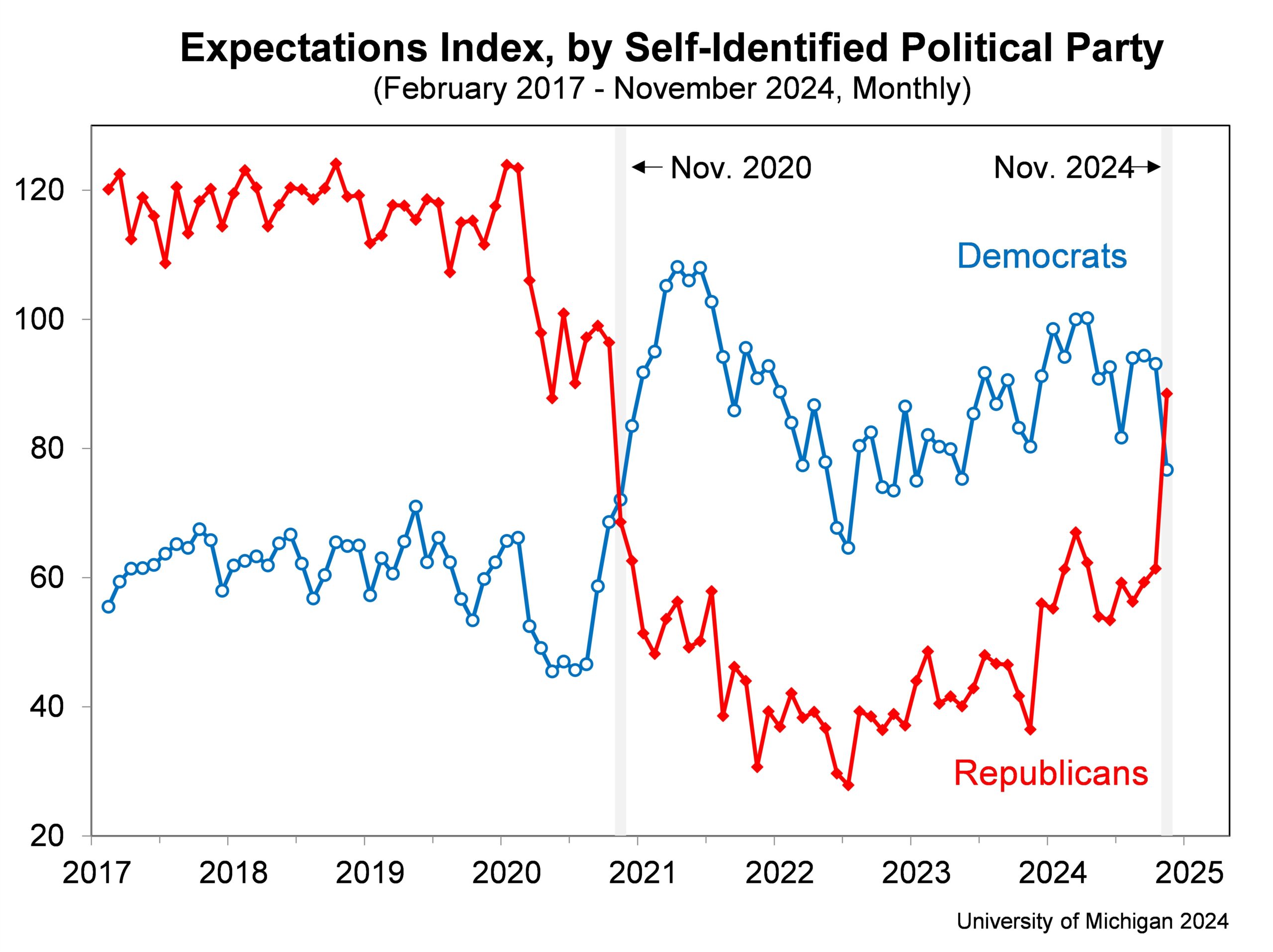
The University of Michigan Consumer Expectations index for the US was revised down to 76.90 points in November 2024 from an initial 78.5. Despite the revision, it remains the highest reading in eight months, up from 74.10 points in October.
Year-ahead inflation expectations dropped to 2.6% in November, the lowest since December 2020, down from 2.7% in October. This decline aligns with pre-pandemic stability, resting within the historical range of 2.3%-3.0%.
Long-Term Economic Outlook
While year-ahead inflation expectations hold steady at 2.6%, long-run inflation expectations climbed to 3.2%, up from 3.0% the previous month, suggesting growing uncertainty about future inflation trends.
This rise hints at growing consumer uncertainty about the Federal Reserve’s inflation control measures and broader economic stability. Notably, the interquartile range of expectations widened, highlighting diverse consumer perspectives on long-term inflation risks.
Historical Context of Consumer Confidence
Since its inception in 1952, the Michigan Consumer Sentiment Index has averaged 85.25 points. The November 2024 reading of 71.8, while an improvement from recent lows, remains well below historical norms. For context, the all-time high of 111.4 occurred in January 2000, and the record low of 50 was recorded in June 2022, reflecting stark contrasts in economic confidence during different periods.
Looking Ahead
The November data underscores a mixed economic outlook. Incremental gains in consumer sentiment signal cautious optimism, tempered by uncertainty about Trump’s economic agenda. The near four-year low in short-term inflation expectations offers a silver lining, suggesting reduced cost-of-living pressures. However, the uptick in long-term inflation concerns highlights the need for close monitoring of monetary policies and consumer confidence trends.
By tracking shifts in consumer sentiment and inflation expectations, policymakers and businesses can better navigate the complexities of economic planning and decision-making in the months ahead.