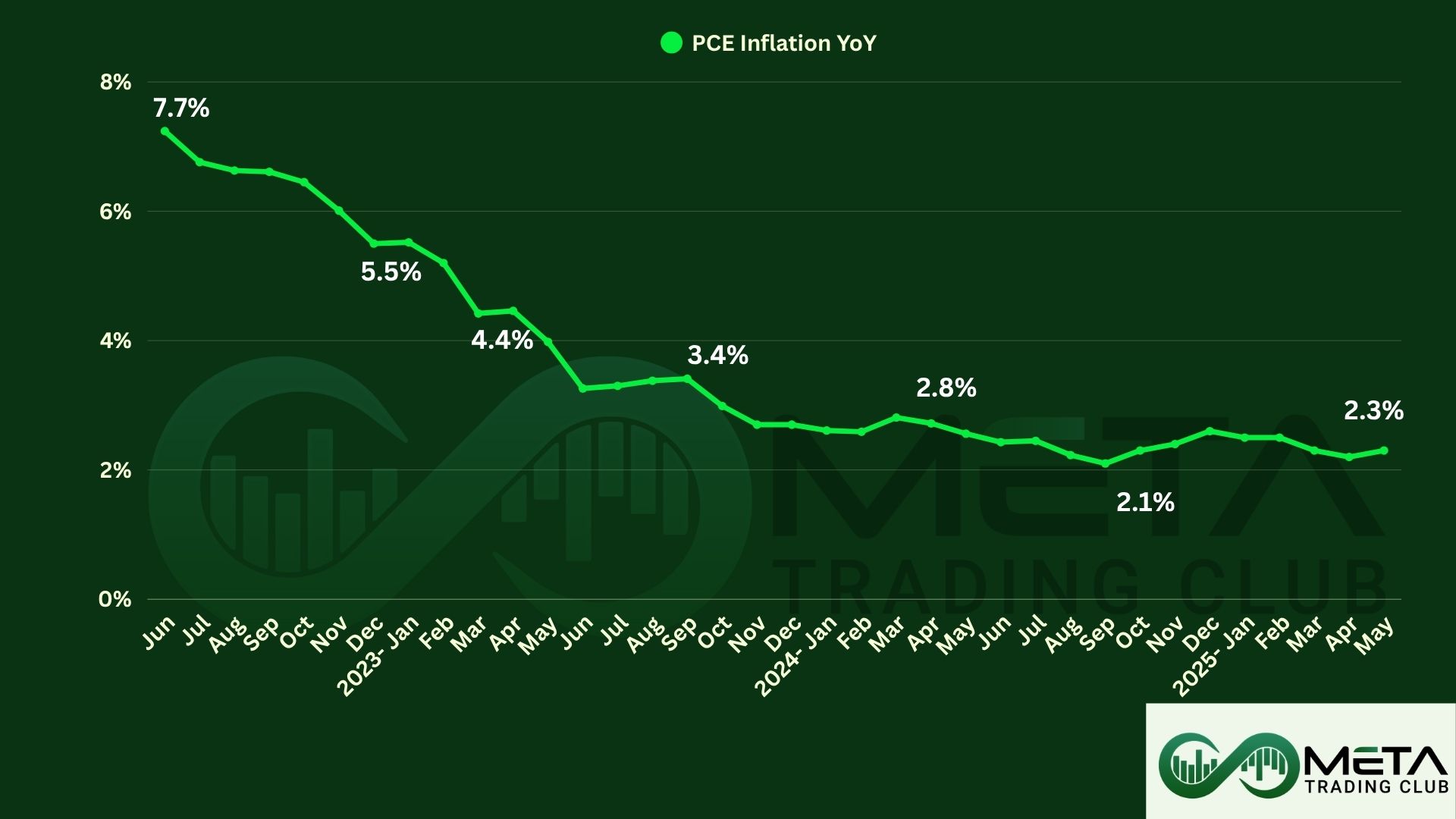
The Personal Consumption Expenditures (PCE) Price Index is a key inflation gauge used by the Federal Reserve to assess the prices of goods and services consumed by households. Unlike the Consumer Price Index (CPI), the PCE adjusts for changing consumer behavior, reflecting how people shift spending as prices change.
Core PCE excludes food and energy prices. Policymakers closely monitor it to understand inflation trends. It is considered a comprehensive measure of inflation. This helps guide decisions on interest rates and monetary policy.
By focusing on core PCE, the Federal Reserve can assess economic stability and inflation risks more effectively.
May PCE Price Index
In May 2025, the United States experienced a notable decline in key income and spending indicators, reflecting potential softening in consumer activity and overall economic momentum.
Personal consumption expenditures (PCE), a key measure of consumer spending, decreased by $29.3 billion or 0.1% in May. This decline primarily reflected a substantial reduction in spending on goods, which fell by $49.2 billion. However, there was a partial offset from a $19.9 billion increase in spending on services, suggesting that while demand for goods weakened, consumers continued to invest in service-based experiences such as travel and healthcare. When adjusted for inflation, real PCE fell by 0.3%, further confirming a slowdown in consumer-driven demand.
Income and Outlays Overview
According to the U.S. Bureau of Economic Analysis, personal income decreased by $109.6 billion, representing a 0.4% drop on a monthly basis. This decline was largely attributed to reductions in government social benefits and lower income from farm proprietors. While there was a modest increase in compensation (particularly wages and salaries) it was not sufficient to offset the broader downturn.
Disposable personal income (DPI), which is the amount of income available to households after accounting for taxes, fell 0.6% or $125.0 billion. When adjusted for inflation, real DPI declined by 0.7%, indicating a tangible erosion in purchasing power. This has important implications for consumer behavior, as households typically adjust their spending patterns in response to changes in real income.
The broader measure of personal outlays, which includes interest payments and transfer payments in addition to PCE, decreased by $27.6 billion in May. Despite this drop in spending, the personal saving rate held relatively steady. Americans collectively saved $1.01 trillion during the month, with the personal saving rate standing at 4.5%. This rate, while not particularly high historically, suggests a degree of financial caution among households amid economic uncertainty.
Price Index Trends
- Month-to-Month Changes: The PCE price index rose 0.1% from the previous month, with core inflation (excluding food and energy) also up 0.2%.
- Year-over-Year Changes: headline PCE inflation rose to 2.3%, while core PCE inflation declined to 2.3%.1.
Impacts of April PCE Data
In summary, the data for May 2025 presents a mixed picture. While inflation remains relatively moderate, the declines in income and consumption underscore mounting pressures on household finances.
The decline in personal income and real disposable income suggests weaker consumer purchasing power, which may raise concerns about slowing economic growth. Lower consumer spending, especially on goods, can weigh on corporate revenues, particularly in retail and consumer-focused sectors.
On the flip side, the modest rise in the PCE price index (0.1% monthly, 2.3% annually) and core inflation (2.7%) reassure investors that inflation is not accelerating. Since the PCE index is the Federal Reserve’s preferred inflation gauge, this could reduce inflationary pressure.