
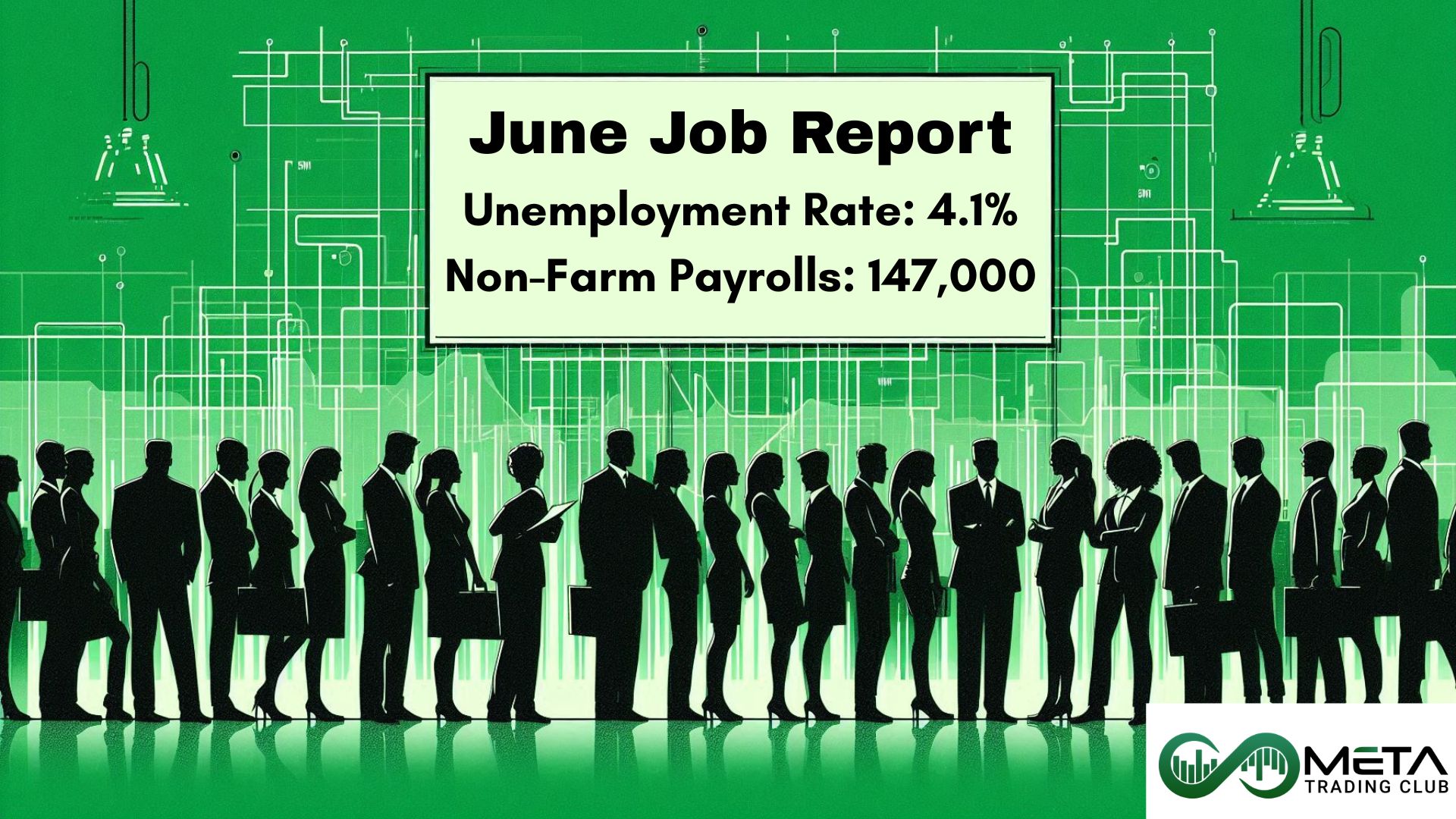
The unemployment rate is a measure of the percentage of the total labor force that is unemployed but actively seeking employment and willing to work. It’s a key indicator of the health of the labor market and the economy. For example, an unemployment rate of 4.2% means that 4.2% of the people who are able and willing to work are currently without a job.
Nonfarm payrolls refer to the total number of paid workers in the U.S. excluding farm employees, government employees, private household employees, and employees of nonprofit organizations. This statistic is reported monthly by the U.S. Bureau of Labor Statistics and is a critical indicator of economic health. An increase in nonfarm payrolls typically signals economic growth and means more jobs creation.
Employment Situation – June 2025
The U.S. labor market maintained steady momentum in June 2025, with nonfarm payroll employment rising by 147,000 jobs. According to the Bureau of Labor Statistics (BLS), the unemployment rate held relatively stable at 4.1%, remaining within its year-long range. Job growth was primarily driven by gains in state government and the healthcare sector, while federal employment continued to decline.

Household Survey Data
- The unemployment rate for Black workers rose to 6.8%, while rates for adult women and Whites fell to 3.6%. Unemployment for other demographic groups saw little or no change.
- The number of long-term unemployed increased to 1.6 million, accounting for over 23% of all unemployed individuals.
- Labor force participation edged slightly lower to 62.3%, while the employment-population ratio held at 59.7%.
- Part-time employment due to economic reasons stayed flat at 4.5 million, and
- The number of individuals not actively looking for work but wanting a job remained at 6 million.
Establishment Survey Data
In the establishment survey, job gains closely mirrored the 12-month average, reinforcing a trend of measured growth.
State government added 47,000 jobs, most notably in education, while local education employment increased by 23,000. Conversely, federal government employment continued its decline, shedding another 7,000 positions in June, totaling a loss of 69,000 since January.
Healthcare employment grew by 39,000, particularly in hospitals and nursing facilities, while social assistance added 19,000 jobs with strong gains in family services. Most other major industries, including manufacturing, construction, and retail, experienced minimal change.
Wages and Work Hours
- Average hourly earnings rose by 8 cents (0.2%) to $36.30 in June, reflecting a modest 0.2% rise. Year-over-year, earnings rose 3.7%.
- Nonsupervisory workers saw slightly higher wage growth of 0.3%, bringing their average hourly pay to $31.24.
- The average workweek edged down by 0.1 hour to 34.2 hours overall, while manufacturing hours remained unchanged.
Impacts of Report on Stock Market
The stronger-than-expected job growth in June, 147,000 new jobs above the forecast, suggests the economy is still resilient. That’s generally good news for the market because it shows businesses are hiring and consumers may keep spending.
Wage growth slowed to just 0.2%, which could ease inflation concerns. Also, Unemployment dipped to 4.1%, showing labor market strength. This could lead to Federal Reserve rate cuts, especially with slower wage growth and inflation cooling.
Overall, employment trends show steady stability, and this resilience in the labor market contributed to an increase in the S&P 500, as investors reacted positively to the steady job data.