The Federal Reserve, often called the Fed, is the central bank of the United States. It manages the country’s money supply and interest rates to keep inflation in check and support job growth.
By adjusting interest rates, the Fed influences borrowing costs, spending, and investment across the economy. Its decisions can have a big impact on financial markets, businesses, and everyday consumers.
Fed Interest Rates Decision January 28, 2026
The Fed kept interest rates unchanged at 3.5%–3.75% during its January 2026 meeting, matching expectations after three rate cuts last year that brought borrowing costs to their lowest level since 2022. Most members voted to hold rates steady, while two preferred a small rate cut. Stephen Miran and Christopher Waller disagreed with the decision and argued for another 25‑basis‑point cut.

What’s Driving the Decision?
The Federal Reserve said the economy is still growing at a solid pace, with job gains staying low and unemployment beginning to stabilize.
Inflation remains higher than desired, so the Fed kept interest rates unchanged at 3.5% to 3.75%.
Policy makers emphasized that future rate decisions will depend on incoming data, the economic outlook, and the balance of risks.
They highlighted ongoing uncertainty in the outlook and noted that decisions will depend on labor market trends, inflation pressures, and global financial conditions.
Fed’s Press Conference
In his press conference, Chair Powell said the U.S. economy is entering 2026 on a strong footing and that current interest rates are appropriate to support progress toward the Fed’s goals of stable prices and maximum employment.
Chair Powell said the economy is entering 2026 on a solid footing and that current rates remain appropriate to support progress on inflation and employment. He emphasized that inflation is still somewhat elevated and that the Fed will continue to make decisions based on incoming data rather than following a preset path.
Powell avoided commenting on the Justice Department investigation and broader political tensions surrounding the Fed, though he acknowledged the importance of central bank independence. He also addressed concerns about affordability, saying reducing inflation remains the best way to ease pressure on households.
Powell noted that tariffs have likely caused a temporary bump in prices but should fade over the year. On technology, he said AI may disrupt some jobs but ultimately boosts productivity and long‑term wage growth.
Markets Reaction
The Fed kept interest rates unchanged, as widely expected, and offered little clarity on when cuts might begin. Markets reacted quietly, with investors noting that the central bank’s message did not meaningfully shift expectations.
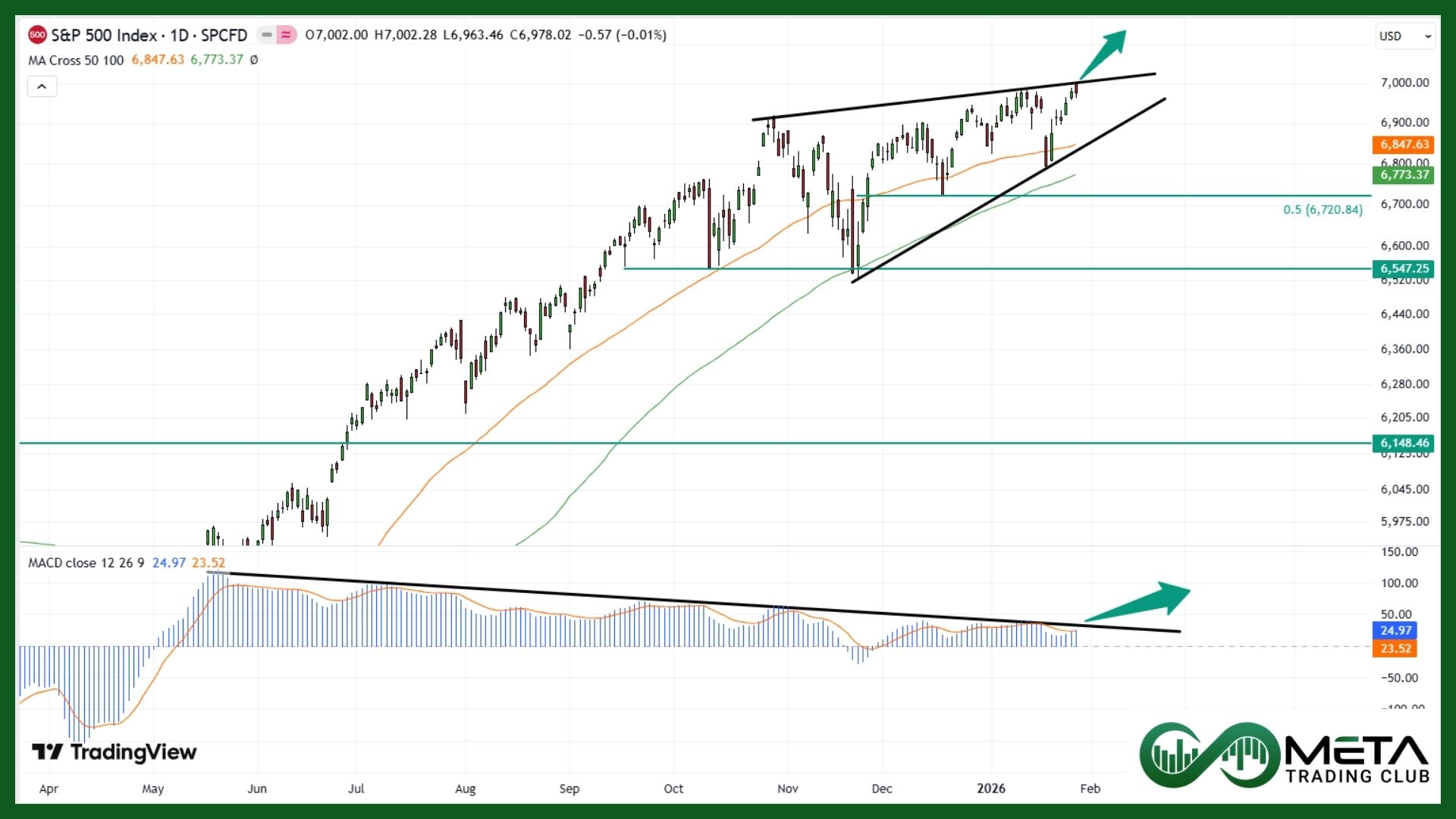
Investor response was muted. The S&P 500 briefly crossed the 7,000 mark earlier in the day, but Powell’s comments left both bullish and bearish investors largely unchanged in their views. Analysts described the tone as slightly hawkish, with some suggesting rate cuts may be further away than markets expect.