The Personal Consumption Expenditures (PCE) Price Index is a key inflation gauge used by the Federal Reserve to assess the prices of goods and services consumed by households. Unlike the Consumer Price Index (CPI), the PCE adjusts for changing consumer behavior, reflecting how people shift spending as prices change.
Core PCE excludes food and energy prices. Policymakers closely monitor it to understand inflation trends. It is considered a comprehensive measure of inflation. This helps guide decisions on interest rates and monetary policy.
By focusing on core PCE, the Federal Reserve can assess economic stability and inflation risks more effectively.
August PCE Price Index
The U.S. Bureau of Economic Analysis released its latest report on personal income and outlays for August 2025, revealing steady gains in both household earnings and consumer spending. Despite ongoing economic uncertainty and elevated interest rates, American consumers continued to show resilience.
Income and Spending Rise
Personal income rose by $95.7 billion, or 0.4% month-over-month, driven mainly by higher employee compensation and government transfer receipts. Disposable personal income (DPI), which reflects income after taxes, also increased by 0.4%, totaling a gain of $86.1 billion.
Consumer spending, measured by personal consumption expenditures (PCE), jumped 0.6%, or $129.2 billion from July. This marks the strongest monthly increase in five months, with $77.2 billion spent on services and $52.0 billion on goods.

Outlays and Savings
Total personal outlays, which include spending, interest payments, and transfers, rose by $132.9 billion in August.
Meanwhile, personal savings reached $1.06 trillion, with the savings rate holding at 4.6% of disposable income. This balance suggests that while consumers are spending more, they’re still maintaining a cautious approach to saving.
Inflation Trends
The PCE price index, a key measure of inflation, rose 0.3% in August, up from 0.2% in July. Core PCE, which excludes food and energy, increased 0.2%, slightly easing from the previous two months.
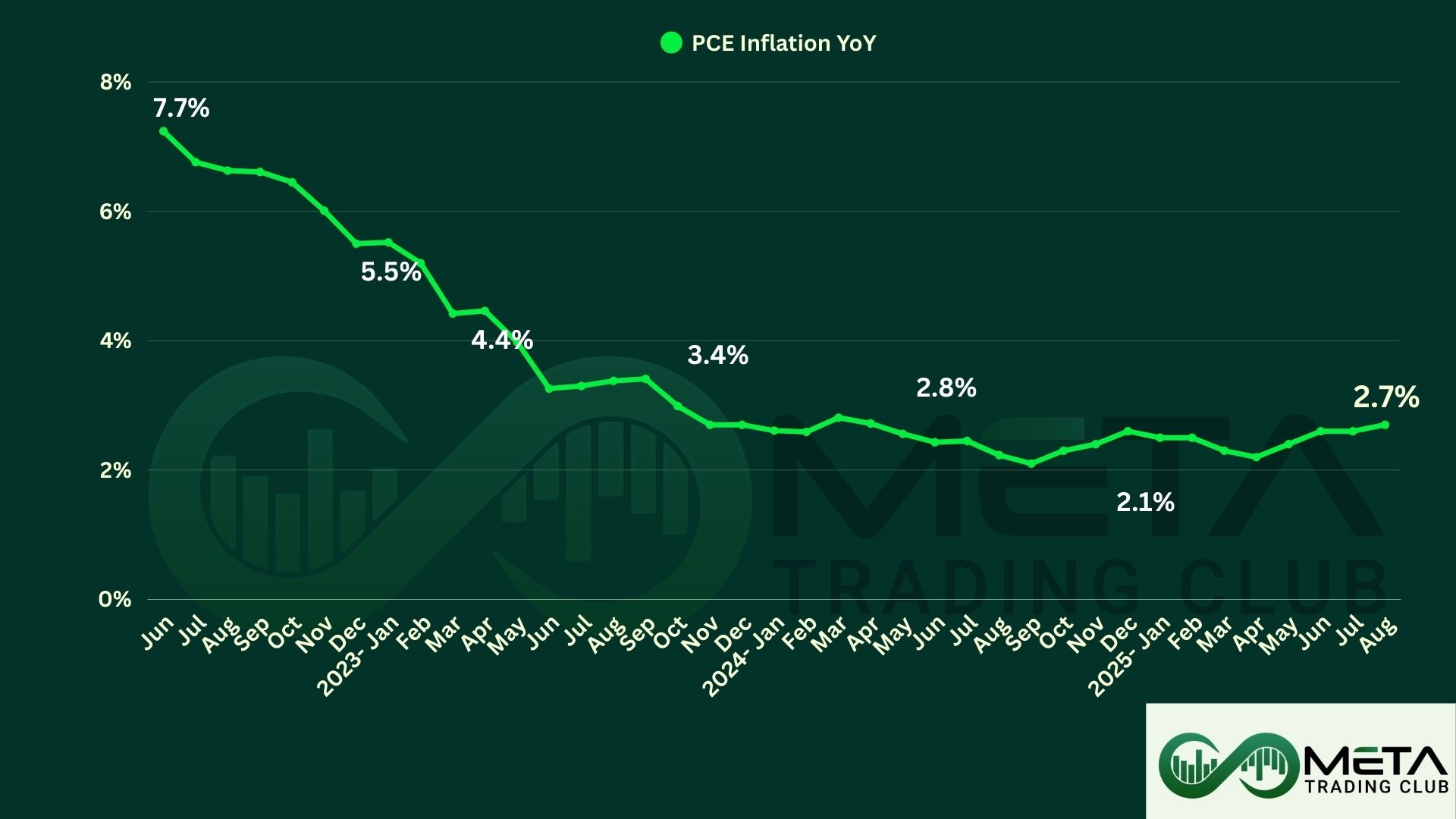
On a year-over-year basis, headline PCE inflation accelerated to 2.7%, the highest in six months, while core PCE held steady at 2.9%, both figures in line with market expectations.
Impacts of August PCE Data
The August PCE inflation report had a mixed impact on the market. Inflation data came as expected, with no surprises, core PCE stayed at 2.9% year-over-year and rose 0.2% month-over-month. That stability, along with a strong 0.6% jump in personal spending (the biggest in five months), helped boost market confidence.
However, the report also showed that inflation is still stubborn, especially in services and essentials, which may cause the Federal Reserve to hold off on cutting interest rates too soon.