Almost every trader who has been around for a while has the same story.
They joined a signal group — paid for alerts, received the notifications, followed the trades. Maybe the first few worked. The screenshots looked impressive. The admin seemed confident. And then, gradually or all at once, the wheels came off.
Some traders lose money directly from the signals. Others break even on the trades but never actually improve. They stay stuck — unable to trade on their own, dependent on someone else’s judgment, with no real understanding of why any particular trade was taken or what to do when conditions change.
This isn’t a coincidence. Signal groups fail traders in predictable, structural ways. And understanding why is actually the first step to building something better.
The uncomfortable truth
Signal groups can win for a while. They still fail the trader — because renting someone’s judgment never becomes your own.
What Signal Groups Promise vs. What They Deliver
The pitch is consistent across essentially every trading signal group:
- Access to professional-level trade ideas
- Proven alerts from experienced traders
- Take trades alongside someone who ‘knows what they’re doing’
- Build your account while you learn
The implicit promise is that you can shortcut the learning curve by leveraging someone else’s expertise. You get the output without having to develop the process.
That promise is the problem.
Not because experienced traders can’t generate good trade ideas — some can. But because the model of consumption — receive alert, copy trade, hope for outcome — structurally prevents you from ever building the skills you actually need.
You don’t learn to drive by being a passenger. You don’t become a trader by copying someone else’s entries.
MTC Analysis
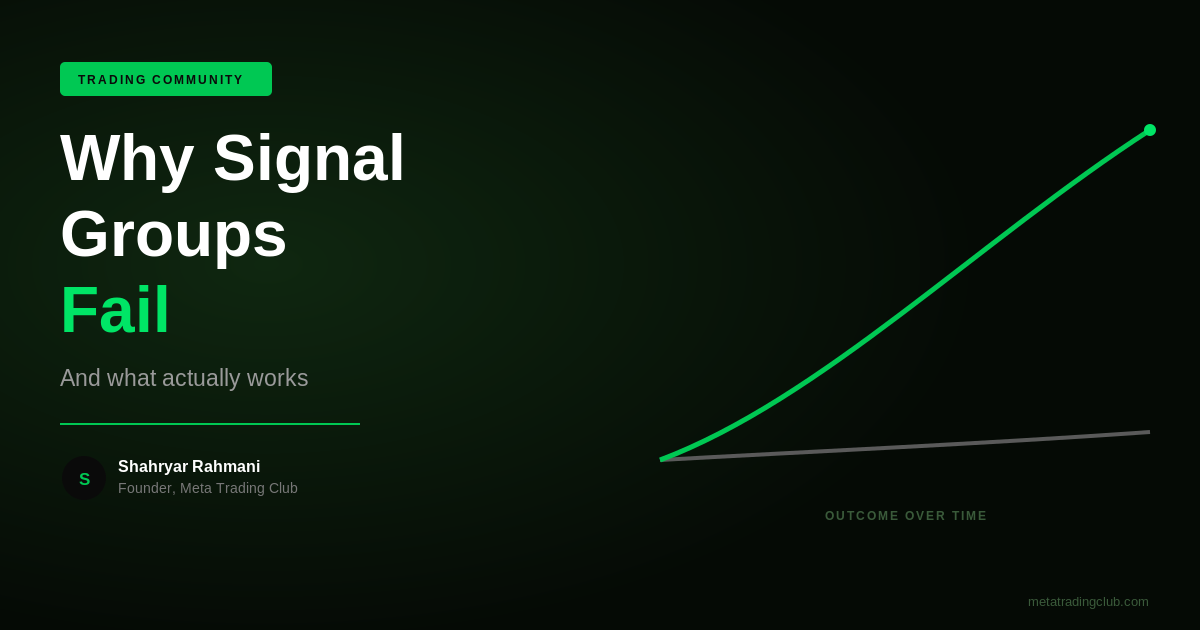
Follower vs. Independent Trader — Over Time
Even when alerts win short-term, the follower builds no skill. The independent trader’s edge compounds.
The Dependency Trap
The most fundamental issue with signal groups isn’t performance — it’s dependency.
When you follow signals without understanding the reasoning behind them, you become completely reliant on that source continuing to perform, continuing to post, and continuing to have your interests at heart. The moment any of those things change, you have nothing.
Think about what you actually need to survive as a trader:
- The ability to read market structure
- A framework for identifying setups
- Risk management that protects your capital when wrong
- The psychological discipline to execute without emotion
- A process for reviewing and improving over time
Signal groups provide none of these. They provide outputs, not inputs. They give you fish without teaching you anything about water.
And because you’re outsourcing your judgment, you also outsource your development. Every week you spend in a signal group is a week you’re not building the skills that will matter when the signals stop.
What Happens When Signals Are Wrong
Here’s where the real damage tends to occur.
When a trade from a signal group goes against you, you have no framework for managing it. The alert told you to enter. Nothing told you where to put your stop, how much to risk, or what conditions would invalidate the trade.
So you either:
- Exit in a panic when it looks bad, taking a larger-than-necessary loss
- Hold through the loss hoping it reverses — because the signal ‘said’ to be in it
- Average down because you’re emotionally attached to being right
None of these are disciplined trading responses. They’re the responses of someone who has been given an entry without the surrounding context that makes that entry manageable.
A trade without a defined risk level, a stop, and an invalidation point isn’t a trade — it’s a bet. Signal groups almost universally provide the first without the rest.
Survivorship Bias in Signal Screenshots
This is worth spending time on because it’s less obvious than the other problems.
The screenshots you see in signal group marketing — the P&L screenshots, the winning trade breakdowns, the ‘this is what members made this week’ posts — are not a representative sample of performance. They are a curated selection.
Good trades get screenshotted. Bad trades get buried. Partial wins get counted as wins. Trades where the admin exited early but the alert stayed live get counted as whatever number looks best.
This isn’t necessarily deliberate fraud in every case. Human psychology naturally highlights wins and minimizes losses. But the effect is the same: you’re making a decision to join based on a deeply distorted picture of actual results.
Most traders who have been in signal groups for a year or more — if they were tracking everything — would find that the actual return, accounting for all trades, all costs, and all the ones that weren’t prominently shared, is far less impressive than the marketing suggested.
The 3 Real Reasons Traders Fail
Signal groups don’t create these problems — they just perpetuate them. These are the actual root causes of why most traders struggle:
1. No Process
Most traders either have no defined methodology at all, or they have a collection of indicators and patterns without a coherent framework for using them. Without a structured process — a clear set of conditions that must be met before a trade is taken — every decision becomes subjective, emotional, and inconsistent.
A process isn’t just ‘I use RSI and moving averages.’ It’s a defined sequence: What is the overall market bias? Where are the key levels? What happens at those levels that matters? What confirmation do I need before entering? What is my risk on this trade?
Process turns trading from a series of guesses into something repeatable and improvable.
2. Poor Risk Management
Risk management is where most trading careers end. Not dramatic blowups (though those happen too) — more often it’s a slow erosion from trades that are too large, stops that are too wide or nonexistent, and position sizing that doesn’t account for account size or the realistic range of outcomes.
Good risk management means knowing before you enter how much you can lose, sizing accordingly, and sticking to it regardless of how ‘sure’ the setup feels. This is a discipline that must be built. It cannot be borrowed from a signal group.
3. Psychology
Even traders with a solid process and good risk management rules fail when they can’t execute those rules under pressure. Fear of loss causes premature exits. Fear of missing out causes impulsive entries. The desire to ‘make back’ a loss causes oversized revenge trades.
These are not character flaws — they’re universal human tendencies under conditions of uncertainty and financial risk. Managing them requires self-awareness, a repeatable routine, and enough experience in the market to trust your process even when it’s uncomfortable.
None of this is developed by copying alerts.
Signal Group vs. Education Community: The Real Comparison
| Feature | Signal Group | Education Community |
|---|---|---|
| What you receive | Alerts | Skills, framework, process |
| Underlying logic explained | Rarely | Always |
| Risk management included | Usually not | Core component |
| What you build over time | Dependency | Independent judgment |
| Performance when source disappears | Stops entirely | Continues and improves |
| Trade reviews of losses | Almost never | Regular — part of the learning process |
| Member development | Stagnant | Progressive |
| Long-term value | Decreasing | Compounding |
| Cost vs. benefit over 12 months | Increasingly poor | Increasingly strong |
What Actually Works Long-Term
The traders who develop real consistency share a set of characteristics that have nothing to do with receiving better signals.
They have a defined framework. They know their criteria before they look at any ticker. They’re not pattern-matching on the fly — they have a clear structure that tells them what to look for and in what sequence.
They manage risk as a primary concern. They know exactly how much they’re risking on every trade before they enter. They’re not thinking about the upside first.
They review their trades systematically. They know why a trade worked, why it didn’t, and what adjustments their process requires. They’re improving continuously.
They’ve internalized discipline at the process level. They don’t need motivation to follow their rules. The rules are just what they do — because they’ve seen enough times that breaking them costs more than following them.
This doesn’t happen overnight. But it absolutely can happen — if you’re in an environment that teaches process instead of just feeding outputs.
Why MTC Is Built Differently
Meta Trading Club was built specifically around this problem.
The community isn’t a signal service. MTC does not post alerts for members to copy. The focus is entirely on building independent traders through a structured, repeatable process — the MTC Alignment Engine.
Every live session is a demonstration of process: What is the market bias today? Where are the key levels? What reaction at those levels is worth watching? What confirmation is required before an entry? What does the risk look like? Members observe this process applied to real, live market conditions daily — and they learn to replicate it themselves.
The goal at MTC is that members eventually don’t need us to tell them what to trade. They understand why a setup is valid or isn’t. They manage their own risk. They make their own decisions — with clarity and confidence — because they have a framework they’ve internalized through real-time repetition.
That’s a fundamentally different outcome than spending months in a signal group and walking away with nothing transferable.
To learn more about what a real trading community looks like, read What Is a Trading Community and Why It Matters, and check out Best Options Trading Community Canada for a comparison of community types.
Stop Renting. Start Building.
Every month in a signal group is a month not spent building the skills that will actually make you a consistent trader.
MTC Community is the alternative — a place where you learn the process, not just the output. Daily live sessions, a structured methodology, honest trade reviews, and a community that measures success by member development, not screenshot impressions.
Start your 7-day free trial at MTC Community →
Build something you own. Not something you borrow.
Proprietary Framework
The MTC Alignment Engine™ — Applied Every Live Session
Every trade runs the same five checkpoints — consistency over gut reaction. Inside the MTC Incubator, members build their own system on top of this framework.
Frequently Asked Questions
Why do signal groups fail traders?
Signal groups fail traders because they create dependency without building skill. When you follow alerts without understanding the reasoning, risk management, or methodology behind them, you’re not developing as a trader — you’re outsourcing your judgment. When the signals stop performing, or the admin disappears, you have nothing to fall back on. The model provides outputs while preventing you from ever building the inputs.
Are any signal groups legitimate?
Some signal providers are genuine and perform well — but even in those cases, the fundamental problem remains: following signals doesn’t develop your ability to trade independently. You’re renting a skill rather than building one. The most legitimate trading services are education-first, where alerts — if provided at all — come with full context, reasoning, and risk parameters, not just entry tickers.
What should I look for instead of a signal group?
Look for a trading community or education program that teaches a defined methodology, runs live sessions where reasoning is explained in real time, and has a culture of risk management and process over entertainment. The goal should be making you independent — not keeping you dependent on a daily notification to know what to do.
What are the three main reasons traders fail?
The three core reasons traders fail are: (1) no defined process — trading without a consistent, structured framework leads to emotional and inconsistent decision-making; (2) poor risk management — taking on too much size, ignoring stops, or not defining risk per trade leads to account erosion over time; and (3) psychology — even traders with good rules struggle to execute them consistently under the pressure of real money and real markets.
How do signal groups use survivorship bias?
Signal groups typically share their winning trades prominently in marketing materials and community highlights while losses get minimized, ignored, or quietly removed. This creates a distorted picture where performance looks much stronger than it actually is. A truly representative record would include every signal posted, every outcome, and every associated cost — which is rarely what gets shared publicly.
Is MTC a signal group?
No. Meta Trading Club is a live trading education community. MTC does not post signals for members to copy. The core offering is daily live sessions where the MTC Alignment Engine framework is applied to real market conditions — teaching members to identify their own setups, manage their own risk, and develop independent trading judgment. The explicit goal is for members to not need alerts — because they’ve built their own process.
Meta Trading Club Community
Start Your 7-Day Free Trial
Daily live sessions. Real-time market prep — not signals. The MTC Alignment Engine™ applied in front of you. Trade alongside Shahryar from day one.
Cancel anytime. No contracts. Built for Canadian traders.
Already trading and want to build your own system?
The MTC Incubator is an application-based mentorship — 1-on-1 work building a personalized system on the Alignment Engine™.