Options trading in Canada is growing fast.
More Canadian retail traders are moving beyond buying stocks into options — attracted by the leverage, the flexibility, and the potential to profit in any market direction.
But the learning curve is steep. And the mistakes beginners make are predictable.
This guide is for Canadian traders who are either brand new to options or haven’t found a clear, structured starting point yet. We’ll cover what options are, how the Canadian landscape differs from the US, what strategies to start with, and — most importantly — how to build the foundation that actually leads to consistent results.
The beginner’s edge
Options reward structure and punish guessing. The good news: as a buyer your risk is defined — you decide your maximum loss before you ever enter the trade.
What Is Options Trading?
An option is a financial contract that gives you the right — but not the obligation — to buy or sell an underlying asset (typically a stock or ETF) at a specific price, before a specific date.
Two types of options:
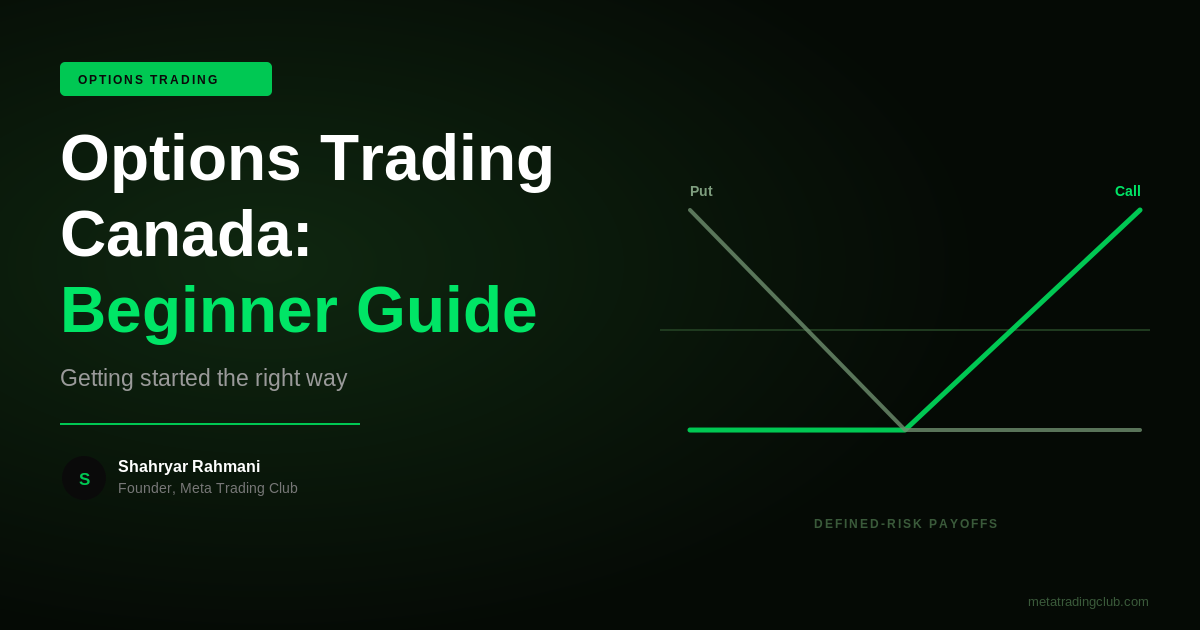
Call option: Gives you the right to buy the underlying asset at the strike price. You buy calls when you believe the price will go up.
Put option: Gives you the right to sell the underlying asset at the strike price. You buy puts when you believe the price will go down.
You pay a premium to buy an option. As a buyer, that premium is your total risk — you can’t lose more than you paid. The trade-off is that options can expire worthless if the stock doesn’t move enough in the right direction.
Why People Trade Options
- Leverage: A small move in the underlying stock can create a much larger percentage move in the option price
- Defined risk: As a buyer, your max loss is the premium paid
- Directional flexibility: You can build strategies for bullish, bearish, or neutral market conditions
- Capital efficiency: You can control 100 shares of a stock with a fraction of what it would cost to buy those shares outright
MTC Analysis
Defined Risk: Why Buyers Can’t Lose More Than the Premium
As a buyer, your downside is fixed the moment you enter — the premium. Knowing your max loss before the trade is the foundation of risk management.
How Options Trading in Canada Differs from the US
Most options trading education online is built for US traders. If you’re starting in Canada, there are important differences to understand:
Broker Access
Not all US brokers are available to Canadians. You need a broker with a Canadian entity or that explicitly accepts Canadian clients. Main options:
- Interactive Brokers Canada
- Questrade
- Tastytrade Canada
- TD Direct Investing (via thinkorswim)
Tax Treatment
In Canada, options trading gains can be taxed as:
- Capital gains (50% of the gain is included in taxable income) — for occasional traders
- Business income (100% of the gain is taxable) — for active traders the CRA considers to be trading as a business
The CRA considers factors like: frequency of trading, time spent, how you describe yourself, and whether trading is your primary income. This is a meaningful distinction. Get advice from a Canadian tax professional before making assumptions.
TFSA and Options Trading
You can trade options in a TFSA, but be careful. The CRA has assessed taxes on ‘active trading’ in TFSAs, treating it as business income — even inside the TFSA. Conservative and occasional use is fine; aggressive active trading in a TFSA carries regulatory risk.
Currency and Market Access
Most Canadian traders focus primarily on US markets (SPY, QQQ, individual US stocks) since they offer far more liquidity for options. Your broker will involve a CAD/USD exchange — understand the currency costs involved.
The Options Chain: How to Read It
The options chain is the dashboard of every options trade. Here’s what the key columns mean:
| Column | What It Means |
|---|---|
| Strike Price | The price at which you have the right to buy (call) or sell (put) |
| Expiration Date | When the contract expires — daily, weekly, monthly |
| Bid | What buyers are currently paying |
| Ask | What sellers are currently asking |
| Last | Most recent transaction price |
| Volume | Contracts traded today (higher = better liquidity) |
| Open Interest | Total open contracts (higher = better liquidity) |
| IV (Implied Volatility) | Market’s expectation of future price movement — affects premium cost |
| Delta | How much the option price moves per $1 move in the underlying |
Practical tip: Stick to options with high volume and open interest when you’re starting. Illiquid options have wide bid/ask spreads that eat your profits on entry and exit.
The Greeks: What You Need to Know
Options are priced using several variables called ‘the Greeks.’ You don’t need to master all of them before your first trade, but understand these:
Delta
Delta measures how much the option price moves for every $1 move in the underlying stock.
- A delta of 0.50 means the option moves $0.50 for every $1 stock move
- At-the-money options are roughly 0.50 delta
- In-the-money options have higher delta; out-of-the-money options have lower delta
Theta
Theta is time decay — the amount the option loses in value each day simply due to the passage of time.
This is one of the most important concepts for beginners to understand: options lose value every day, all else being equal. Time works against buyers. If the stock doesn’t move, your option is worth less tomorrow than today.
Vega
Vega measures sensitivity to changes in implied volatility (IV). When IV is high, options are expensive. When IV drops after a catalyst (like earnings), option prices can fall even if the stock moves in your direction. This is called ‘IV crush.’
Gamma
Gamma is the rate of change in delta. It becomes most relevant as options approach expiration and for very short-dated contracts.
Beginner Options Strategies for Canadian Traders
Start simple. These four strategies give you defined risk and straightforward execution:
1. Long Call (Bullish, Defined Risk)
When to use: You believe a stock or ETF will move higher in the near term.
How it works: Buy a call option. Your max risk is the premium paid. Your max profit is theoretically unlimited (until expiration).
Best practices:
- Buy at-the-money or slightly in-the-money (avoid cheap far OTM calls)
- Give yourself enough time — 30–60 days minimum
- Have a target and a stop before entering
2. Long Put (Bearish, Defined Risk)
When to use: You believe a stock or ETF will move lower.
How it works: Buy a put option. Max risk is the premium paid.
Best practices: Same as long calls — avoid extremely cheap far OTM puts, give yourself time, have exits defined before entry.
3. Bull Call Spread (Bullish, Lower Cost)
When to use: Bullish, but want lower cost and defined risk on both sides.
How it works: Buy a call at a lower strike, sell a call at a higher strike. Your max risk is the net premium paid. Your max profit is the difference between strikes minus the premium paid.
Why use a spread over a single call: Lower entry cost, lower maximum loss. The trade-off is that your upside is capped.
4. Bear Put Spread (Bearish, Lower Cost)
When to use: Bearish, but want lower cost and defined risk.
How it works: Buy a put at a higher strike, sell a put at a lower strike. Max risk is net premium paid.
What to Avoid as a Beginner
- Naked short calls or puts — unlimited risk, not for beginners
- Complex multi-leg strategies (iron condors, butterflies) — too many variables before you’ve mastered the basics
- 0DTE (same-day expiration) trading — extremely fast-moving, requires experienced execution
- Earnings plays without understanding IV — IV crush can destroy your position even if the stock moves your way
How to Develop a Trading Process (Not Just Trade Ideas)
Here’s what separates traders who eventually get consistent from those who stay stuck:
The inconsistent trader finds a setup that looks good, buys an option, sets no stop, has no defined exit, holds hoping it works, exits emotionally at the wrong time.
The consistent trader asks a series of structured questions before every trade:
- What is the market doing overall right now? What’s my bias?
- What key level is price interacting with?
- How is price reacting at that level?
- What confirmation do I need before entering?
- How many contracts can I buy so my max loss is within my risk parameters?
This is the framework MTC teaches as the MTC Alignment Engine. It’s not a specific strategy — it’s a decision-making process that applies to any setup, on any day.
The goal is to remove ambiguity. Every trade decision should be the result of a process, not a feeling.
Building Your Daily Trading Routine
Consistency in trading comes from routine. Here’s what a structured trading day looks like:
Premarket (30–60 minutes before open)
- Check overall market futures (ES, NQ)
- Review any overnight news (Fed announcements, earnings, geopolitical)
- Identify market bias for the day
- Mark key levels on your charts
Market Open (First 30 minutes)
- Observe, don’t just execute. The first 30 minutes can be volatile and deceptive.
- Wait for your setups to develop relative to your premarket analysis
During the Session
- Trade setups that meet your full criteria — not partial setups
- Follow your risk parameters without exception
- If you hit your daily loss limit, stop
Post-Market (End of day)
- Review your trades: what worked, what didn’t, what could be improved
- Log in your trading journal
The Role of a Trading Community in Your Development
Solo trading has a ceiling.
You can learn the mechanics from courses and YouTube. But without live market exposure and feedback, you’ll keep making the same mistakes — or develop bad habits you don’t even know you have.
The fastest path to development is being in an environment where you watch experienced traders work through the market live, with full explanation of their reasoning. This is what live trading communities provide.
Meta Trading Club runs live premarket sessions every trading day — covering market bias, key levels, and what setups are developing. Members watch live trade execution and learn the MTC Alignment Engine as a consistent decision-making framework.
For Canadian beginner options traders, it’s one of the fastest on-ramps to structured trading available. And there’s a 7-day free trial with no commitment.
Next Steps
If you’re just getting started with options trading in Canada, here’s your action plan:
- Learn the basics — calls, puts, the options chain, delta, theta
- Choose a broker — Questrade, IBKR Canada, or Tastytrade Canada
- Apply for Level 2 options approval
- Paper trade for 4–8 weeks — get comfortable before risking real capital
- Join a live education community — compress your development curve
The most important thing isn’t the first trade you take. It’s the process you build.
Start your 7-day free trial at Meta Trading Club →
Full access. No payment required to start.
Proprietary Framework
The MTC Alignment Engine™ — Applied Every Live Session
Every trade runs the same five checkpoints — consistency over gut reaction. Inside the MTC Incubator, members build their own system on top of this framework.
Frequently Asked Questions
What is options trading in Canada for beginners?
Options trading in Canada involves buying or selling financial contracts that give you the right — not the obligation — to buy or sell a stock or ETF at a specific price before a specific date. For beginners in Canada, the best starting point is learning the fundamentals (calls, puts, Greeks), choosing a Canadian-compatible broker like Questrade or IBKR Canada, and starting with defined-risk strategies like long calls and puts.
Is options trading legal in Canada?
Yes. Options trading is fully legal in Canada for retail investors. You need to open a trading account with a registered broker and apply for options trading approval. Most brokers provide access to both Canadian and US options markets.
What broker should I use for options trading in Canada?
The most popular choices for Canadian options traders are Interactive Brokers Canada (best for advanced traders), Questrade (accessible for beginners), and Tastytrade Canada (built specifically for options traders). The right choice depends on your experience level and trading style.
How much money do you need to start options trading in Canada?
You can start with as little as $2,000–$5,000, though having $10,000+ gives you more flexibility for proper position sizing. The key principle is never risking more than 1% of your account on a single trade, regardless of your account size.
What is the safest way to trade options as a beginner in Canada?
The safest approach for beginners is buying long calls or puts (defined risk, maximum loss is the premium paid), using proper position sizing (never more than 1% of account at risk per trade), setting a daily loss limit and stopping when you hit it, and focusing on high-liquidity underlyings like SPY and QQQ.
Can I trade options in a TFSA in Canada?
Yes, but with caution. The CRA may treat frequent active options trading in a TFSA as business income, which is taxable even within the account. Conservative and occasional use is generally safer. Consult a Canadian tax professional before using your TFSA for active options trading.
How long does it take to learn options trading in Canada?
Understanding the mechanics takes weeks. Developing a consistent, profitable process takes 1–2 years for most serious traders. The timeline shortens considerably when you’re in a structured live education environment rather than learning in isolation.
Meta Trading Club Community
Start Your 7-Day Free Trial
Daily live sessions. Real-time market prep — not signals. The MTC Alignment Engine™ applied in front of you. Trade alongside Shahryar from day one.
Cancel anytime. No contracts. Built for Canadian traders.
Also worth exploring: