Most traders who eventually join a trading community say the same thing:
‘I wish I had done this sooner.’
They spent months — sometimes years — trading alone. Learning the hard way. Blowing accounts, rebuilding, making the same mistakes in different forms. Eventually they found a structured community and their development accelerated.
The question isn’t really what is a trading community. It’s: why do traders wait so long to join one?
Usually it’s a combination of skepticism (are these just signal groups trying to take my money?) and ego (I should be able to figure this out on my own).
Both are understandable. Both slow you down.
This post explains what a real trading community is, what it does, what to look for, and how to know if it’s the right next step for you.
Why traders wait too long
Most traders who finally join a community say the same thing: ‘I wish I’d done this sooner.’ Skepticism and ego keep people trading alone — and trading alone is the slowest way to learn.
What Is a Trading Community?
A trading community is a structured environment where traders learn, practice, and develop together — guided by an experienced educator or group of educators.
The best trading communities are not:
- Signal groups (where you copy alerts without understanding them)
- Chatrooms full of noise and opinions
- One-and-done courses
- Social media clout accounts
The best trading communities are:
- Live learning environments with daily market sessions
- Places where a structured methodology is taught and practiced consistently
- Communities where you can ask questions and get real feedback
- Safe spaces to talk about losses, emotional struggles, and process issues — not just wins
The core value isn’t the signals or the tips. It’s the environment — and the feedback loop that environment creates.
MTC Analysis
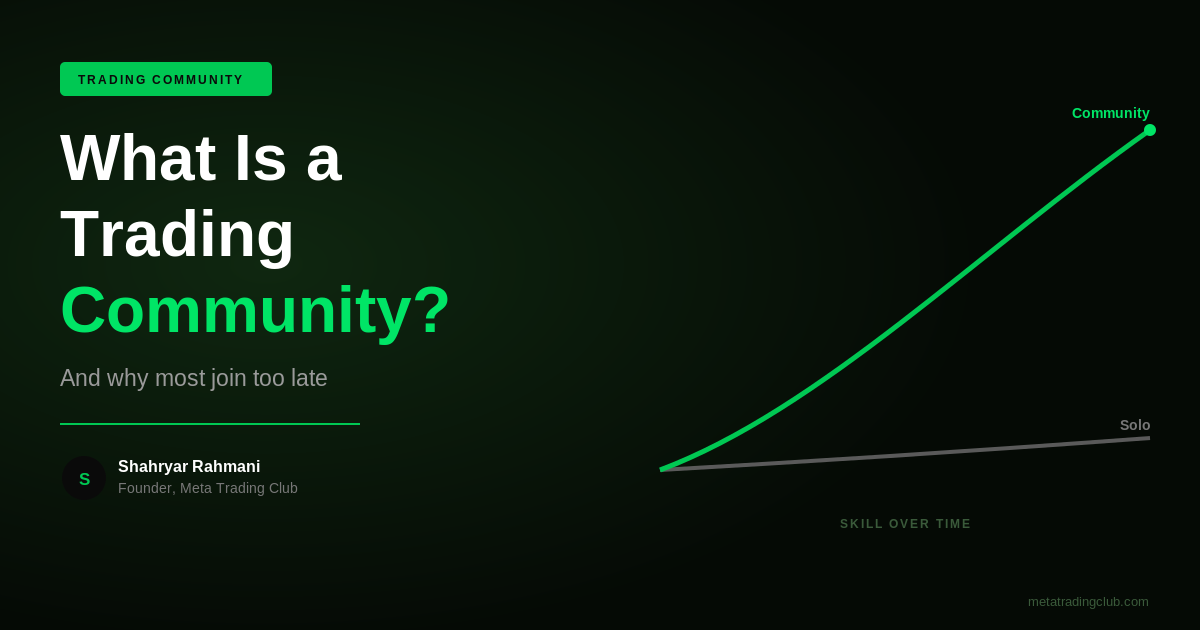
Solo vs. Community — Skill Development Over Time
The gap isn’t intelligence or effort — it’s the feedback loop. A structured environment compounds skill faster.
What Does a Trading Community Actually Do?
Let’s break this down concretely. Here’s what you get in a well-structured trading community:
1. Daily Market Context
Every trading day is different. A good trading community provides a daily briefing that covers:
- Overall market direction and bias
- Key levels to watch (support, resistance, areas of interest)
- What setups might form and under what conditions
- What news or macro context affects the day
This alone is valuable. Most retail traders spend their mornings reacting to market moves rather than preparing for them. A daily premarket session forces you to approach the day with a plan.
2. Live Trade Analysis
Watching someone trade live — with running commentary — is fundamentally different from reading about trading or watching post-trade recaps.
In a live environment, you hear:
- ‘I’m seeing price approach this key level — I’m going to wait and see how it reacts before considering an entry.’
- ‘The confirmation I needed didn’t come, so I’m passing on this trade.’
- ‘This is an A+ setup according to our framework. Here’s my entry, stop, and target.’
This is how trading process gets internalized. You start to hear your own inner commentary developing — the structured thinking that separates disciplined traders from impulsive ones.
3. A Repeatable Framework
One of the most common problems for retail traders: they don’t have a consistent process. They use different criteria every day depending on how they feel.
A trading community that teaches a defined methodology gives you a filter. Instead of asking ‘should I take this trade?’ you ask ‘does this trade meet the criteria of my framework?’ That shift removes emotion from the equation.
At Meta Trading Club, members learn the MTC Alignment Engine — a 5-step process that applies the same analysis criteria to every potential trade, every day.
4. A Place to Talk About Losses
This one is underrated.
Trading is psychologically demanding. Every trader goes through losing streaks, emotional spirals, and confidence crises. Trading alone means you have no one to help you reality-check whether you’re in a normal rough patch or actually making systematic errors.
A community creates a space where those conversations happen safely — without judgment. When you see that other traders go through the same thing, it normalizes the experience and helps you manage it more effectively.
5. Accountability
Simply knowing that other people are in the same sessions, following the same framework, and comparing notes creates accountability. You’re less likely to revenge trade when you know you’ll have to review your decisions in a community setting.
Signal Group vs. Trading Community: The Key Difference
This is the most important distinction to understand.
| Signal Group | Trading Community |
|---|---|
| Sends trade alerts | Teaches you to identify your own trades |
| You copy without understanding | You learn the reasoning behind every decision |
| Dependency increases over time | Independence increases over time |
| Value disappears if you stop paying | Skills stay with you forever |
| No feedback on your process | Active feedback on how you’re developing |
| Focused on short-term results | Focused on long-term skill development |
Signal groups create customers. Trading communities create traders.
If your goal is to actually develop as a trader — to eventually be able to trade independently with confidence — a signal group gets you nowhere. You’re renting someone else’s edge.
A real trading community is teaching you to build your own.
Why Most Traders Join Too Late
Here’s the pattern that plays out with most retail traders:
Month 1–3: Excited, consuming content, paper trading or trading small.
Month 4–12: Taking bigger positions, trying different strategies, some wins but not consistent. Starting to feel the emotional pressure.
Month 12–24: Experiencing significant losses. Grinding through a rough patch. Trading alone and getting frustrated by lack of progress.
Eventually: Finding a structured community, getting real live education, and realizing within weeks that the environment was the missing piece.
The traders who join early — before making the expensive mistakes — compress this timeline dramatically.
The skepticism that keeps people out (‘these are just money grabs’) is understandable. But it costs you time. And in trading, time spent grinding through mistakes alone is expensive.
The way to protect yourself from a bad community isn’t to avoid all communities. It’s to know what to look for. Transparency, live education, a structured methodology, and a trial period are your filters.
Is a Trading Community Worth the Money?
The honest answer: it depends entirely on the quality of the community.
A signal group at $200/month that teaches you nothing is worthless. You’ll pay indefinitely and have nothing to show for it the moment you leave.
A structured education community at $99/month that gives you:
- Live daily sessions
- A repeatable trading framework
- Active feedback on your development
- Risk management discipline
- A supportive community
…is worth many multiples of that. Because you’re building a skill, not renting an alert.
Think about it in terms of the alternative cost. If trading alone costs you an extra 6 months of mistakes before you figure something out, and those mistakes cost you $5,000–$10,000 in losses, then $99/month for quality education is a rounding error.
The question to ask isn’t ‘can I afford this?’ — it’s ‘what is my development costing me right now?’
How to Evaluate a Trading Community Before Joining
Before paying for any trading community, run it through this checklist:
Live sessions, not just recordings Can you watch the educator analyze the market live, before trades happen? Or are you only seeing recaps after the fact?
Losing trades are discussed openly Does the educator only share wins? Or do they walk through losing trades and explain what went wrong?
A defined, teachable methodology Is there a specific framework the community teaches? Or is every session just the educator’s opinions?
Risk management is core, not optional Is risk management discussed in every session, or is it an afterthought?
Trial period available Can you try the community before paying? This is the most basic signal of confidence from the operator.
Active, responsive community Are questions answered? Is the Discord or chat active? Does it feel like a real community or a ghost town?
Meta Trading Club: A Structured Trading Community for Canadian Options Traders
Meta Trading Club hits every one of these criteria.
Daily live premarket sessions — every trading day, before the open Live trade execution — with real-time commentary The MTC Alignment Engine — a defined 5-step methodology every member learns Trade reviews including losing trades — every week Active Discord community — questions answered, analysis shared daily 7-day free trial — full access, no payment required
MTC is built for Canadian options traders who want to develop real, independent trading skills. Not just people to follow.
The Bottom Line
A trading community isn’t a shortcut. It’s a learning environment.
The traders who develop fastest aren’t necessarily the smartest or most disciplined by nature. They’re the ones who found a quality environment early, committed to the process, and leveraged the feedback loop that only a live community can provide.
If you’re trading alone right now and not improving the way you want to be — this is probably why.
Start your free 7-day trial at Meta Trading Club →
Proprietary Framework
The MTC Alignment Engine™ — Applied Every Live Session
Every trade runs the same five checkpoints — consistency over gut reaction. Inside the MTC Incubator, members build their own system on top of this framework.
Frequently Asked Questions
What is a trading community?
A trading community is a structured environment where traders learn and develop together, guided by an experienced educator. It typically includes live daily market sessions, a defined trading methodology, risk management education, and community support. The best trading communities build independent traders — they don’t create dependency on signals.
Is joining a trading community worth it?
Yes, if the community provides live education, a structured framework, and genuine feedback on your development. Communities that only provide trade signals are not worth the cost long-term. The value of a real trading community is that it compresses your development timeline and helps you avoid expensive mistakes you’d otherwise make alone.
What is the difference between a trading community and a signal group?
A signal group sends you trade alerts to copy without explanation. A trading community teaches you the process of identifying and executing trades yourself. Signal groups create dependency. Trading communities build independence and transferable skill.
How do I know if I need a trading community?
If you’ve been trading for more than 6 months and don’t yet have a consistent, defined process — or if you’re making the same mistakes repeatedly — a structured community is almost certainly what you’re missing. Most traders who eventually join one say they wish they had done it sooner.
What should I look for in a trading community?
Look for: live daily sessions (not just recordings), transparent discussion of losing trades, a defined teachable methodology, risk management as a core focus, an active community, and a trial period before payment is required.
How much does a trading community cost?
Quality trading communities typically range from $50–$200/month. Meta Trading Club is $99/month with a 7-day free trial. Always evaluate ROI in terms of skill development and mistakes avoided — not just the monthly fee.
Meta Trading Club Community
Start Your 7-Day Free Trial
Daily live sessions. Real-time market prep — not signals. The MTC Alignment Engine™ applied in front of you. Trade alongside Shahryar from day one.
Also worth exploring: