If you’re in Canada and thinking about getting into options trading, the good news is that the barrier to entry is lower than it’s ever been. Brokers are accessible, resources are abundant, and you can open an account and start learning with real money within a few days.
The bad news is that accessibility doesn’t equal preparedness.
Options trading is one of the most powerful financial tools available to retail traders — and one of the easiest ways to lose money fast if you approach it without a framework.
This guide walks you through exactly how to start options trading in Canada: the right way, in the right order.
Start here
Accessibility isn’t preparedness. You can open an options account in Canada in a few days — but the order you learn in decides whether you build a skill or just fund the market’s lessons.
What Is Options Trading?
Options are financial contracts that give you the right, but not the obligation, to buy or sell an asset at a specific price (the strike price) before a specific date (the expiration).
Two types:
- Call option — the right to buy a stock at a set price
- Put option — the right to sell a stock at a set price
You pay a premium to buy an option. That premium is your maximum risk as a buyer. You don’t have to own the underlying stock — you’re trading the contract.
Why people trade options instead of stocks:
- Leverage — a small move in the stock creates a larger percentage move in the option
- Defined risk — buying options means you can only lose the premium paid
- Flexibility — you can profit in up, down, or sideways markets depending on your strategy
But leverage cuts both ways. Options can expire worthless. Theta (time decay) works against you as a buyer every day. Understanding these mechanics before you trade is non-negotiable.
MTC Analysis
Your First 90 Days — The Order That Actually Works
Most blown accounts come from jumping straight to live money. The order matters more than the speed.
Step 1: Learn the Foundational Concepts First
Before you open a live account, get clear on the following:
The Options Chain
An options chain shows every available contract for a given stock or ETF — organized by expiration date and strike price. You need to understand how to read one before anything else.
Key columns to understand:
- Strike price — the price at which the contract gives you the right to buy/sell
- Expiration — the date the contract expires
- Bid/Ask — what buyers are paying and what sellers are asking
- Volume — how many contracts traded that day (liquidity indicator)
- Open Interest — total open contracts (another liquidity indicator)
- IV (Implied Volatility) — the market’s expectation of future price movement; high IV means expensive options
- Delta — how much the option price moves per $1 move in the underlying
The Greeks
You don’t need to master all the Greeks before your first trade, but you should understand:
- Delta — directional exposure
- Theta — daily time decay (works against buyers)
- Vega — sensitivity to volatility changes
- Gamma — rate of change in delta
Basic Strategies to Start With
As a beginner, stick to directional strategies where your risk is defined:
- Long calls — bullish, defined risk (premium paid)
- Long puts — bearish, defined risk (premium paid)
- Bull call spreads — bullish, lower cost than a long call, capped upside
- Bear put spreads — bearish, lower cost than a long put, capped upside
Avoid selling naked options, iron condors, strangles, or complex multi-leg strategies until you have at least 6–12 months of experience.
Step 2: Choose the Right Broker in Canada
Not all brokers in Canada offer options trading. Here are your main choices:
Interactive Brokers Canada (IBKR)
Best for: Active traders and those who want access to the most sophisticated platform
Pros: Low commissions, advanced tools, US options access, margin accounts, professional-grade platform
Cons: Interface is complex for beginners, account minimums can be higher
Options approval: Multi-tier, you’ll need to apply and demonstrate some knowledge
Questrade
Best for: Canadian beginner to intermediate traders
Pros: Well-known, Canadian-based, user-friendly interface, TFSA and RRSP compatible, reasonable commissions
Cons: Platform isn’t as powerful as IBKR for advanced options strategies
Options approval: Standard approval process, accessible for beginners
Tastytrade Canada
Best for: Options-focused traders who want US-style options trading from Canada
Pros: Built specifically for options traders, excellent educational content, intuitive options-focused interface, competitive commissions
Cons: Relatively newer to the Canadian market
Options approval: Streamlined, options-first design
TD Direct Investing
Best for: Traders who already bank with TD and want a familiar environment
Pros: Integration with TD banking, access to thinkorswim (advanced charting platform)
Cons: Higher commissions than IBKR or Tastytrade
What Account Type to Use
In Canada, you can trade options in:
- TFSA (Tax-Free Savings Account) — profits are tax-free. However, the CRA considers frequent active trading as business income, which is taxable even in a TFSA. Understand this distinction before trading aggressively in a TFSA.
- RRSP — options trading is limited and generally not recommended for active options strategies
- Margin Account (Non-Registered) — most flexible for active options trading, but profits are taxable
For most active options traders in Canada, a non-registered margin account gives you the most flexibility. Consult a Canadian tax professional on your specific situation.
Step 3: Get Options Approval on Your Account
Most brokers in Canada require you to apply for options trading approval. They tier it:
- Level 1: Covered calls only
- Level 2: Buying calls and puts (directional trading) — this is where beginners should start
- Level 3: Spreads (defined-risk multi-leg strategies)
- Level 4: Selling naked options (not for beginners — unlimited risk)
When applying, answer honestly about your experience and financial situation. Most beginners get Level 2, which is exactly where you should start.
Step 4: Paper Trade Before You Risk Real Money
Every serious trading educator will tell you this: paper trade first.
Paper trading means simulating trades with fake money. Most brokers offer this. You place the same trades you would with real money, but nothing is at risk.
The purpose of paper trading:
- Get comfortable with the broker platform and order entry
- Start building mechanical intuition for how options prices move
- Test your analysis framework without emotional pressure
- Identify mistakes before they cost you real money
Paper trade for at least 4–8 weeks before going live. Track every trade in a journal: your thesis, entry, exit, result, and what you learned.
Step 5: Learn How to Read the Market
Options don’t exist in isolation. Every options trade is a bet on how a stock or index is going to move. That means you need to be able to read the market — not perfectly, but with a consistent framework.
At minimum, you need to understand:
Market Bias
What direction is the broader market (SPY, QQQ) aligned in? What’s the macro trend? What are institutions doing? If the overall market is in a downtrend, long calls on individual stocks become lower probability.
Key Levels
Where are the significant price levels — highs, lows, areas where price has reversed multiple times? These are your roadmap. Price tends to react at these levels, and they’re where your best trade setups will appear.
Confirmation
Don’t enter a trade based on prediction. Enter based on confirmation. Wait for price to show you what it’s doing at a key level before committing capital.
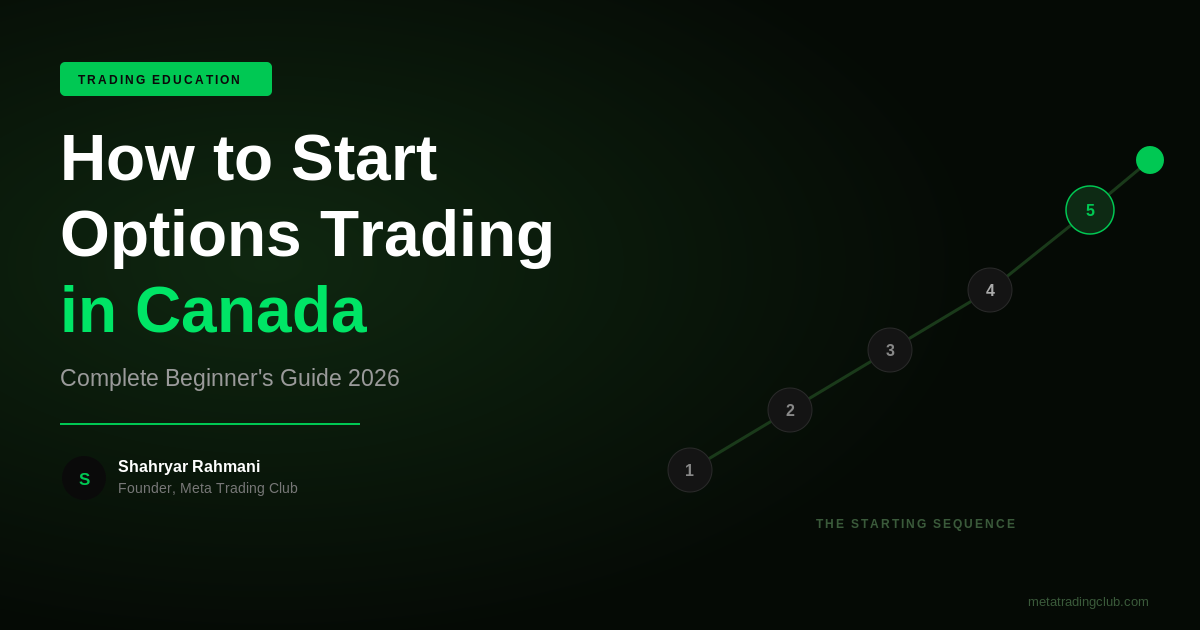
This is the foundation of the MTC Alignment Engine — a 5-step framework that MTC members use every day:
- Market Bias
- Key Level
- Reaction
- Confirmation
- Execution
If you’re looking for a structured way to develop your market reading skills, Meta Trading Club’s live daily sessions walk through this framework every morning before the open.
Step 6: Set Risk Management Rules Before You Trade
Most beginner traders blow accounts not because they were wrong about direction, but because they had no risk management.
Here are the rules to have in place before your first live trade:
1% Rule per Trade Never risk more than 1% of your total account on a single trade. If your account is $10,000, your maximum loss per trade is $100. This means you can survive 10 losses in a row and still have 90% of your capital.
Maximum Daily Loss Limit Set a hard daily limit — many traders use 2–3% of their account. If you hit it, you stop trading for the day. No exceptions. This prevents revenge trading spirals.
Define Your Exit Before Entry Before entering any trade, you know exactly where you’re getting out if you’re wrong. ‘I’ll see how it goes’ is not a risk management strategy.
Size Based on Actual Stop Loss Don’t size your position based on how much you want to make. Size it based on how much you’re willing to lose. Calculate: if my stop is hit, how many contracts mean I lose no more than $X?
Step 7: Get Into a Live Learning Environment
The fastest way to accelerate your development is to be around experienced traders while markets are open.
This isn’t just about following along — it’s about hearing the reasoning behind trade decisions in real time. Why is this level significant? Why wait for this confirmation? Why not hold this through earnings?
That’s the kind of education that builds independent thinking. And it’s only available in a live environment.
Meta Trading Club offers a 7-day free trial with full access to all live sessions, resources, and the community. It’s the fastest way to see if live education accelerates your development.
Common Beginner Mistakes to Avoid
Trading options on low-volume, illiquid underlyings Stick to high-volume ETFs and stocks (SPY, QQQ, AAPL, TSLA) where the bid/ask spread is tight. Illiquid options will eat your profits on entry and exit.
Buying cheap, far out-of-the-money options These expire worthless most of the time. They’re cheap because the probability of profit is low. Start with at-the-money or slightly in-the-money options until you understand probability.
Not accounting for IV (Implied Volatility) Buying options when IV is extremely elevated means you’re paying inflated premiums. Learn what ‘IV rank’ means and how to use it.
Ignoring earnings dates Holding options through earnings introduces IV crush risk — the option can drop in value even if the stock moves in your direction. Check earnings dates before holding options overnight.
Overtrading You don’t need to trade every day. Wait for high-quality setups. Quality beats quantity.
Frequently Asked Questions
How do I start options trading in Canada as a beginner?
Start by learning the foundational concepts (calls, puts, options chains, Greeks), choose a Canadian broker like Questrade, Interactive Brokers Canada, or Tastytrade Canada, apply for Level 2 options approval, paper trade for 4–8 weeks, and join a live trading education community to develop your market reading skills before risking real capital.
Which broker is best for options trading in Canada?
For beginners, Questrade and Tastytrade Canada are accessible starting points. For more advanced traders, Interactive Brokers Canada offers the most powerful platform and lowest commissions. The right choice depends on your trading style and experience level.
Can you trade US options from Canada?
Yes. Most Canadian brokers with options approval (especially IBKR Canada and Tastytrade Canada) give you access to US options markets — including SPY, QQQ, and major US stocks. This is where most Canadian options traders focus.
How much money do you need to start options trading in Canada?
You can technically start with $2,000–$5,000, but you’ll have more flexibility with $10,000+. The key is to use proper position sizing from the start — never risk more than 1% of your account on a single trade, regardless of account size.
Is options trading profitable in Canada?
Options trading can be profitable, but it requires consistent education, a defined methodology, proper risk management, and emotional discipline. Most retail traders who fail do so because they lack structure — not because options themselves don’t work. The path to profitability is through process, not guessing.
How is options trading taxed in Canada?
In Canada, options trading profits may be taxed as capital gains (50% inclusion rate) or as business income (fully taxable) depending on the frequency and intent of your trading. The CRA looks at factors like frequency, time spent, and whether trading is your primary income source. Consult a Canadian tax professional familiar with trading income for your specific situation.
Meta Trading Club Community
Start Your 7-Day Free Trial
Daily live sessions. Real-time market prep — not signals. The MTC Alignment Engine™ applied in front of you. Trade alongside Shahryar from day one.
Also worth exploring: