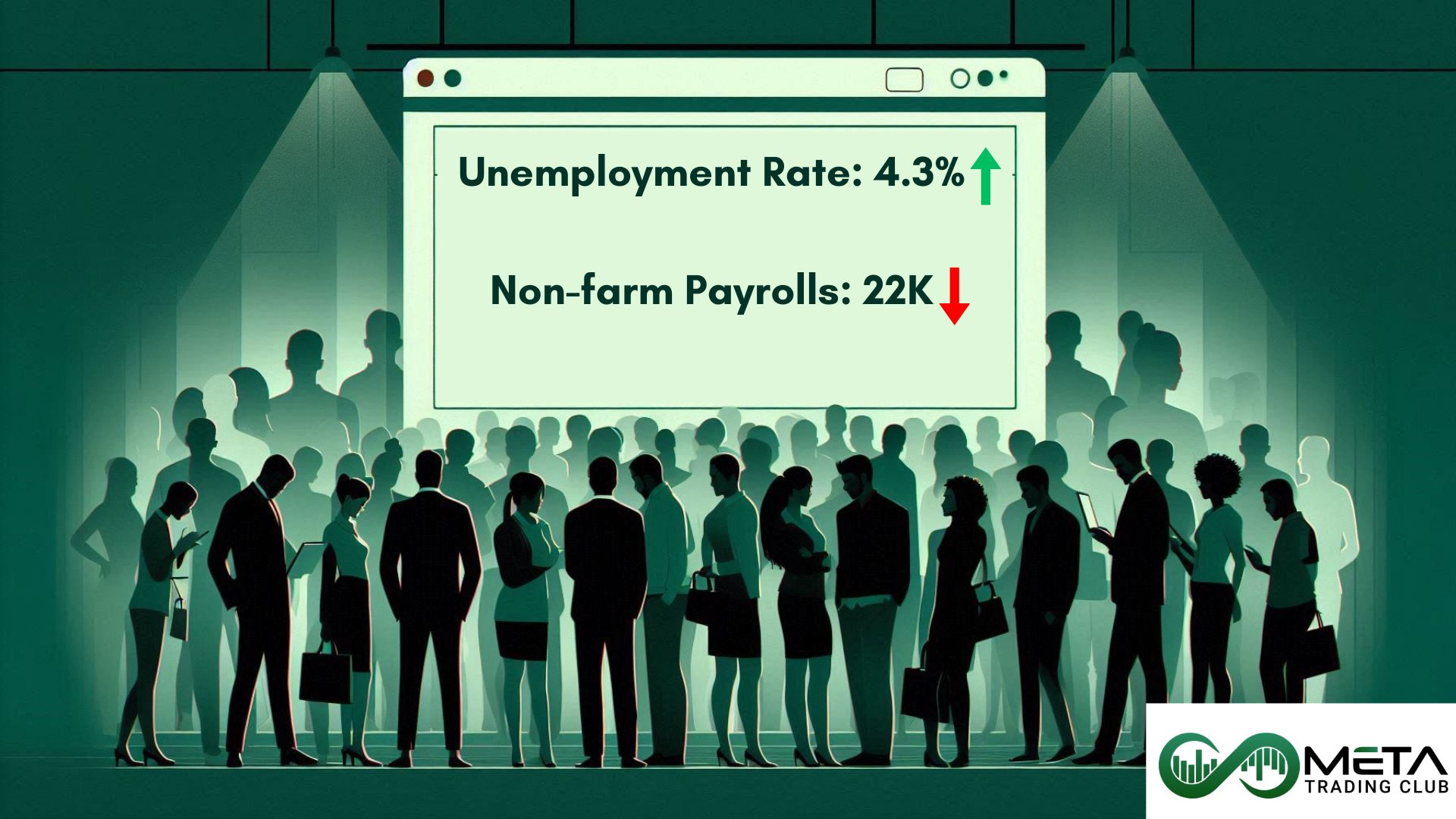
The unemployment rate is a measure of the percentage of the total labor force that is unemployed but actively seeking employment and willing to work. It’s a key indicator of the health of the labor market and the economy. For example, an unemployment rate of 4.2% means that 4.2% of the people who are able and willing to work are currently without a job.
Nonfarm payrolls refer to the total number of paid workers in the U.S. excluding farm employees, government employees, private household employees, and employees of nonprofit organizations. This statistic is reported monthly by the U.S. Bureau of Labor Statistics and is a critical indicator of economic health. An increase in nonfarm payrolls typically signals economic growth and means more jobs creation.
Employment Situation – August 2025
The U.S. labor market showed minimal movement in August, with nonfarm payrolls increasing by just 22,000 jobs, according to the Bureau of Labor Statistics (BLS). This marks the fourth consecutive month of little change in employment. The unemployment rate held steady at 4.3%, indicating a cooling but stable labor market.

Labor Force Overview
- The number of unemployed people remained at 7.4 million, with no major shifts across key demographic groups.
- New entrants to the labor force (those seeking their first job) fell by 199,000 to 786,000, reversing gains from July.
- Long-term unemployment (27 weeks or more) remained at 1.9 million, making up 25.7% of all unemployed, and has risen by 385,000 over the past year.
- The labor force participation rate stayed at 62.3%, while the employment-population ratio held at 59.6%, both down 0.4 percentage points year-over-year.
- Part-time employment for economic reasons remained at 4.7 million.
- The number of people not in the labor force but wanting a job was 6.4 million, up 722,000 from last year.
- Marginally attached workers (those not actively job hunting but available) stood at 1.8 million, with 514,000 classified as discouraged workers.
Industry Employment Trends
- Health care added 31,000 jobs, with gains in ambulatory services (+13,000), nursing and residential care (+9,000), and hospitals (+9,000).
- Social assistance grew by 16,000 jobs, mainly in individual and family services.
- Federal government employment declined by 15,000 and is down 97,000 since January.
- Mining, quarrying, and oil and gas extraction lost 6,000 jobs.
- Wholesale trade employment dropped by 12,000, totaling a 32,000 decline since May.
- Manufacturing shed 12,000 jobs, with transportation equipment manufacturing down 15,000 due to strike activity.
- Other major sectors, including construction, retail, transportation, finance, professional services, hospitality, and information, saw little change.
Wages and Hours
Average hourly earnings for all private nonfarm employees rose by $0.10 (0.3%) to $36.53. Over the past year, wages increased by 3.7%.
Production and nonsupervisory employees saw a $0.12 (0.4%) increase, bringing their average hourly wage to $31.46.
Impacts of Report on Stock Market
The August 2025 U.S. jobs report, reflecting growing concerns about a cooling labor market and its implications for monetary policy. With only 22,000 jobs added, far below expectations of 75,000, and the unemployment rate ticking up to 4.3%, investors saw clear signs of economic slowdown. This weaker-than-expected data increased speculation that the Federal Reserve may cut interest rates as early as mid-September to support growth. This led Spy to new record high.