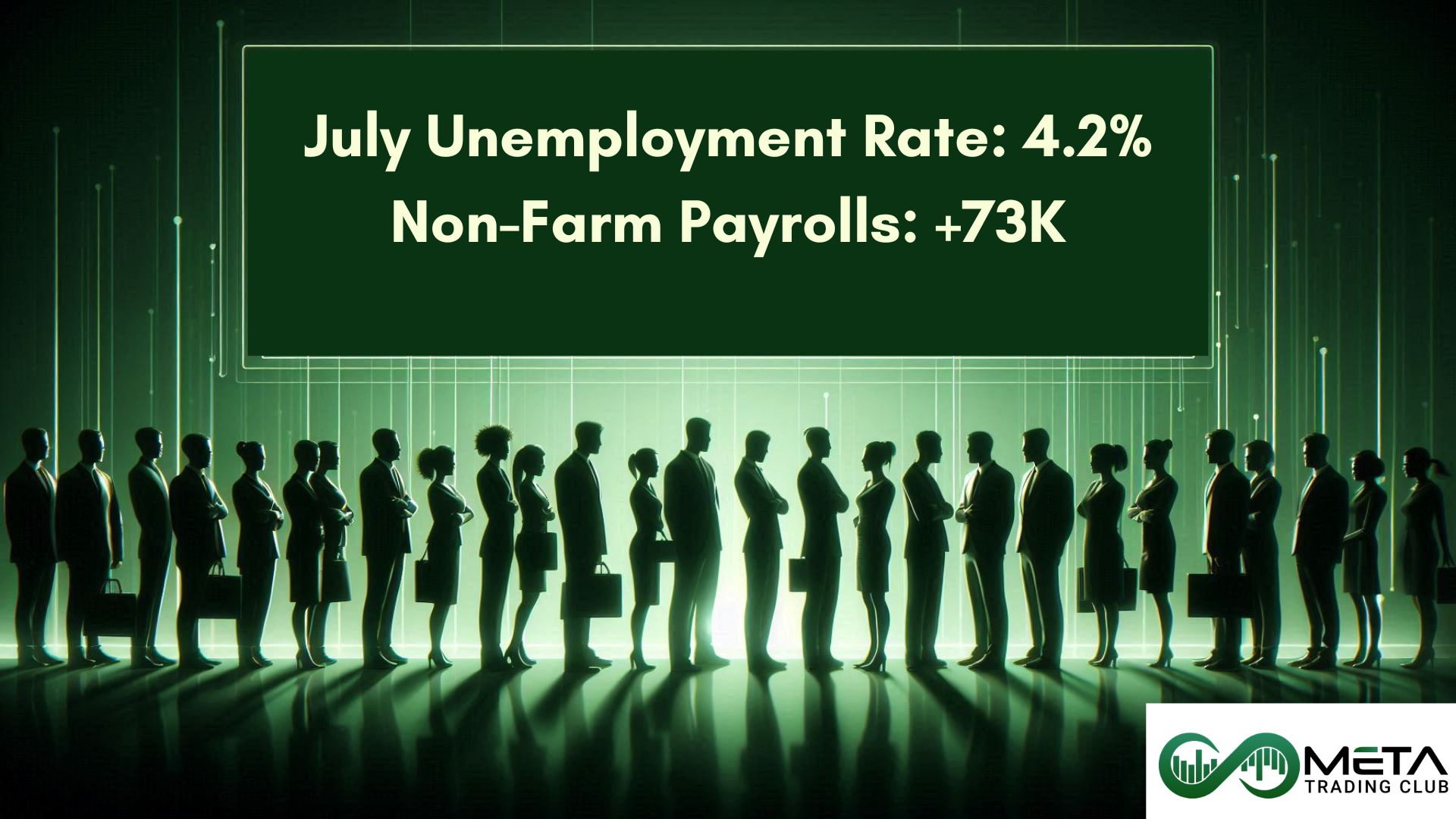
The unemployment rate is a measure of the percentage of the total labor force that is unemployed but actively seeking employment and willing to work. It’s a key indicator of the health of the labor market and the economy. For example, an unemployment rate of 4.2% means that 4.2% of the people who are able and willing to work are currently without a job.
Nonfarm payrolls refer to the total number of paid workers in the U.S. excluding farm employees, government employees, private household employees, and employees of nonprofit organizations. This statistic is reported monthly by the U.S. Bureau of Labor Statistics and is a critical indicator of economic health. An increase in nonfarm payrolls typically signals economic growth and means more jobs creation.
Employment Situation – July 2025
The Labor Department reported an increase of just 73,000 jobs for the month, far fewer than the expected 110,000. This sharp slowdown in hiring reinforced investor unease already heightened by ongoing trade policy uncertainties.
Despite the weak payroll numbers, the unemployment rate remained at 4.2%, consistent with forecasts. Average hourly earnings rose 0.3% over the month, matching expectations and suggesting that wage growth remains steady even as job creation falters.
Household Survey Data
In July, the unemployment rate remained steady at 4.2%, with the number of unemployed persons holding at 7.2 million. The rate has remained between 4% and 4.2% since May 2024.
Notably, the number of new entrants to the job market rose by 275,000 to 985,000, and the long-term unemployed increased by 179,000 to 1.8 million, accounting for nearly a quarter of total unemployed.
The labor force participation rate ticked down to 62.2%, its lowest since November 2022, while the employment-population ratio edged down to 59.6%, the weakest since December 2021.
The number of individuals employed part-time for economic reasons stayed at 4.7 million. Those not in the labor force but wanting a job remained at 6.2 million, up 568,000 over the year.
Establishment Survey Data
Nonfarm payrolls grew by just 73,000 in July, showing minimal change since April. Gains were concentrated in health care (+55,000) and social assistance (+18,000), particularly in ambulatory services and hospitals. Employment in individual and family services rose by 21,000. However, federal government employment continued its downward trend, losing 12,000 jobs and totaling a decline of 84,000 since January.
Employment in other sectors, including manufacturing, construction, retail, and professional services, remained largely flat over the month.

Wages and Work Hours
Average hourly earnings for all employees on private nonfarm payrolls increased by 0.3%, or 12 cents, to $36.44 in July. Over the past year, wages have risen by 3.9%. Nonsupervisory and production employees saw an 8-cent increase to $31.34. The average workweek for all employees edged up by 0.1 hour to 34.3 hours. For manufacturing workers, hours held at 40.1 while overtime slipped to 2.8 hours. Nonsupervisory employee hours also ticked up by 0.1 to 33.7.
Impacts of Report on Stock Market
The July employment report showed signs of a cooling labor market, with nonfarm payrolls increasing modestly and the unemployment rate holding steady at 4.2%.
Labor force participation dipped slightly and the number of long-term unemployed rose. On the wage front, average hourly earnings increased reaching $36.44. The average workweek edged up slightly across sectors.
Overall, the report painted a picture of a labor market losing steam but avoiding sharp contraction.