
As we look back on 2025, understanding the financial forces that shaped markets is essential. Geopolitical shifts, climate disruptions, AI breakthroughs, and monetary policy changes all influenced global markets and investor sentiment.
This review highlights 2025’s key financial developments, including market movements, policy decisions, and emerging risks and opportunities. Looking ahead to 2026, we consider growth sectors, macroeconomic challenges, and strategic choices for investors and traders.
With insight and perspective, we enter 2026 prepared to make informed decisions in a fast‑changing global economy.
2025 Highlights: Pivotal Moments of the Year
Looking back at 2025, it’s evident that many significant events have deeply influenced the global financial markets:
- Global Political Shift: Donald Trump is inaugurated as the 47th U.S. President, marking a major turn in U.S. domestic and foreign policy. Tariffs quickly return as a central economic tool, reshaping global trade dynamics.
- Middle East Turmoil Peaks: Israel launches Operation Rising Lion, striking Iranian nuclear facilities and escalating regional tensions. A Gaza ceasefire reshapes political dynamics, while conflicts in Sudan worsen humanitarian conditions.
- Major Climate Disasters: 2025 sees destructive typhoons and wildfires, including a major California wildfire that becomes one of the year’s defining natural disasters.
- Economic & Trade Tensions: U.S. tariff policy triggers renewed global trade friction, affecting supply chains and sparking diplomatic disputes. Global debt concerns rise through mid‑year.
- AI & Tech Breakthroughs: AI remains one of the most influential forces of the year. Breakthroughs such as Gemini 3 and the rapid expansion of AI governance frameworks reshape global tech competition and regulation.
- Space exploration surged in 2025: More than 309 global launches, a growing number of nations joining the Artemis Accords to deepen lunar cooperation, and major agencies accelerating Mars and deep‑space missions—cementing space as one of the year’s most dynamic and fast‑advancing sectors.
- Climate Change Agreements: COP30 in the Amazon becomes one of the most consequential climate summits in years. Nations negotiate new climate‑finance mechanisms and commitments to protect the Amazon rainforest, shaping environmental policy heading into 2026.
- Sudan Conflict Deepens: Attacks by the Rapid Support Forces lead to mass displacement and worsening humanitarian conditions across the region
- Precious Metals Surge: Gold and silver rally sharply mid‑year as investors respond to geopolitical risk, climate‑related disruptions, and expectations of slower global growth.
2025 Market Review
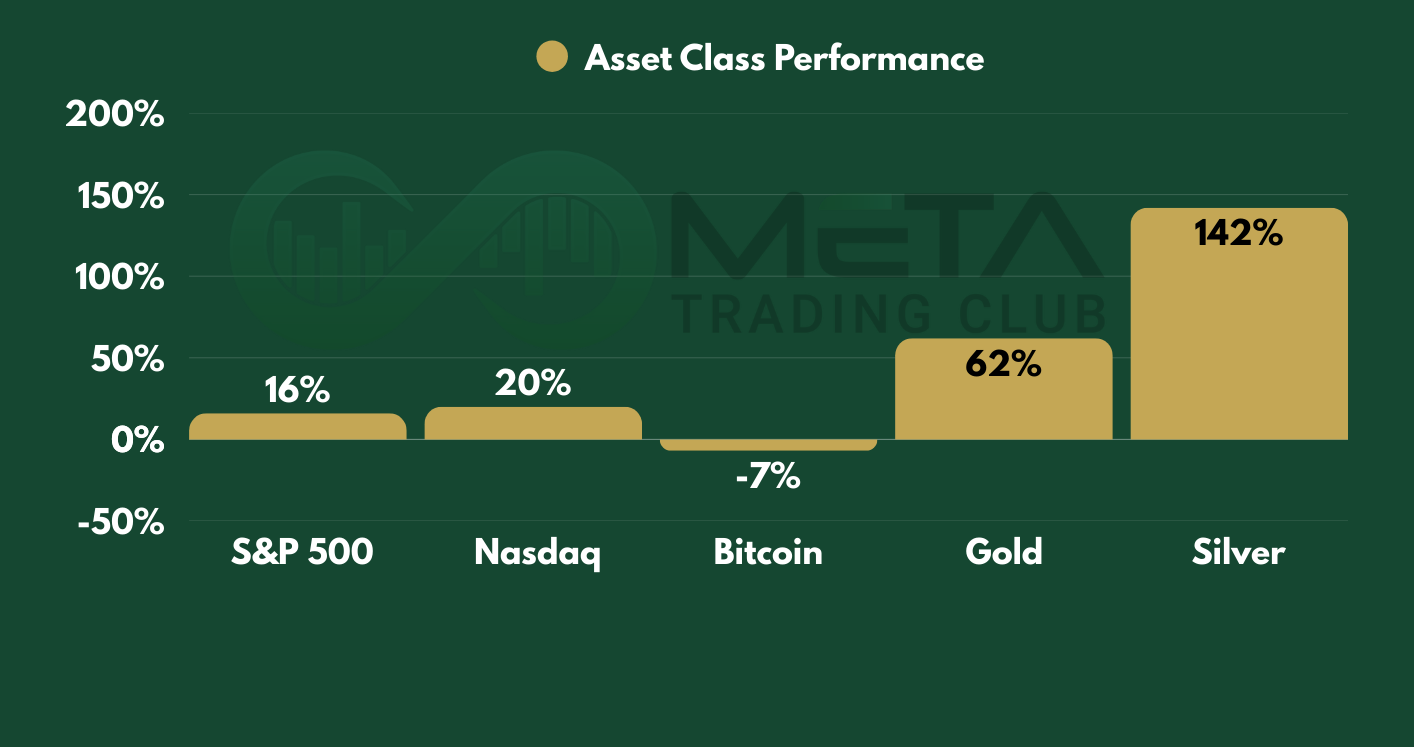
In 2025, various asset classes showed strong and divergent performance:
- S&P 500: Stocks ended the year with solid gains, as the S&P 500 rose about 16% and the Nasdaq jumped 20%, marking a third straight year of strong, AI‑driven growth. The Dow was up 13%, rising more slowly because it has less exposure to major tech companies.
- Gold: Gold prices surged 62%, driven by heightened geopolitical uncertainty, central‑bank buying, and investor demand for safe‑haven assets amid currency volatility.
- Bitcoin: Bitcoin had a difficult year, falling 7% as tighter liquidity, shifting regulatory signals, and reduced risk appetite weighed on major digital assets.
Top Stock Performers of 2025
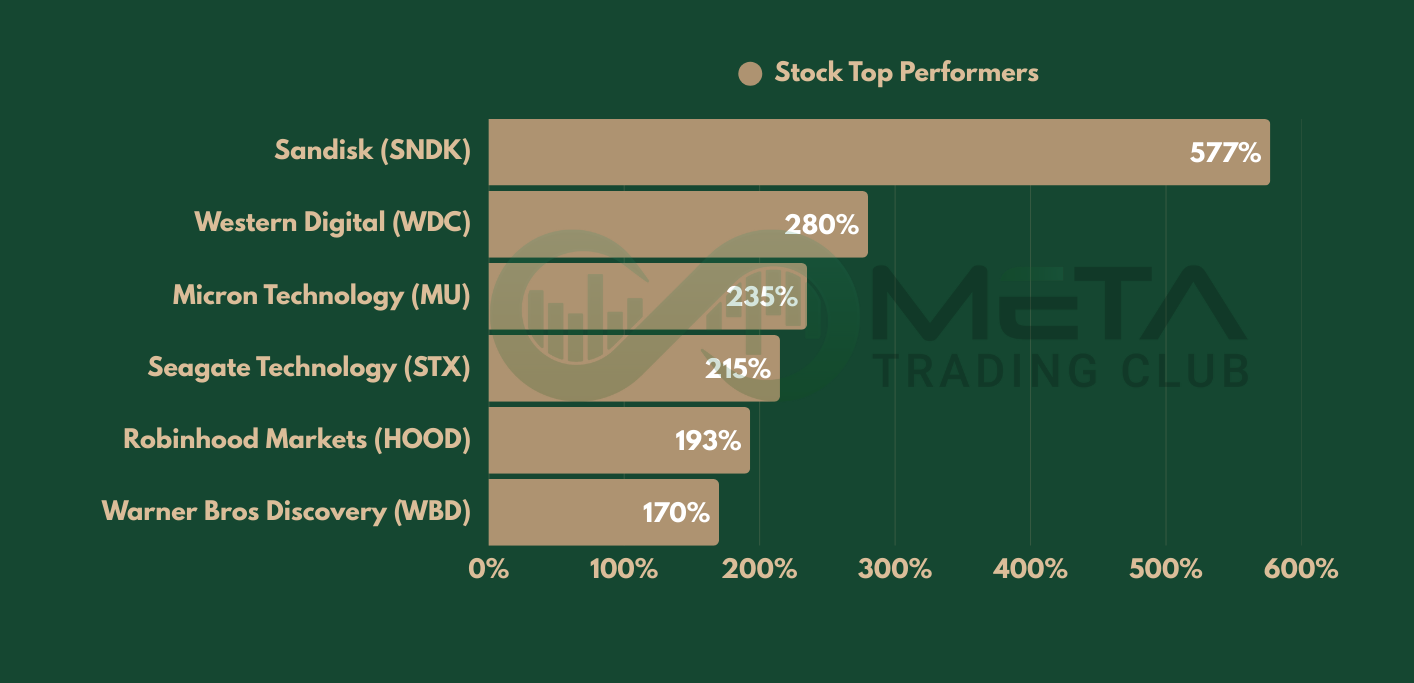
The 2025 equity landscape revealed a sharp divergence between storage‑driven tech winners and media or consumer‑platform laggards.
SanDisk led the market with explosive gains fueled by surging demand for high‑capacity memory and a powerful rebound in pricing, while Western Digital and Seagate also benefited from the AI‑driven expansion of data‑center infrastructure. Micron joined the outperformers as DRAM and NAND markets tightened and AI server shipments accelerated.
Sector Trends
- Tech & AI dominated: Data storage and chipmakers surged due to AI demand and supply constraints.
- Gold rebounded: Newmont’s 170% gain reflected strong safe-haven flows amid geopolitical tension and inflation.
- Fintech & media rallied: Robinhood and Warner Bros posted strong recoveries after a volatile 2024 performance.
Cryptos Performance
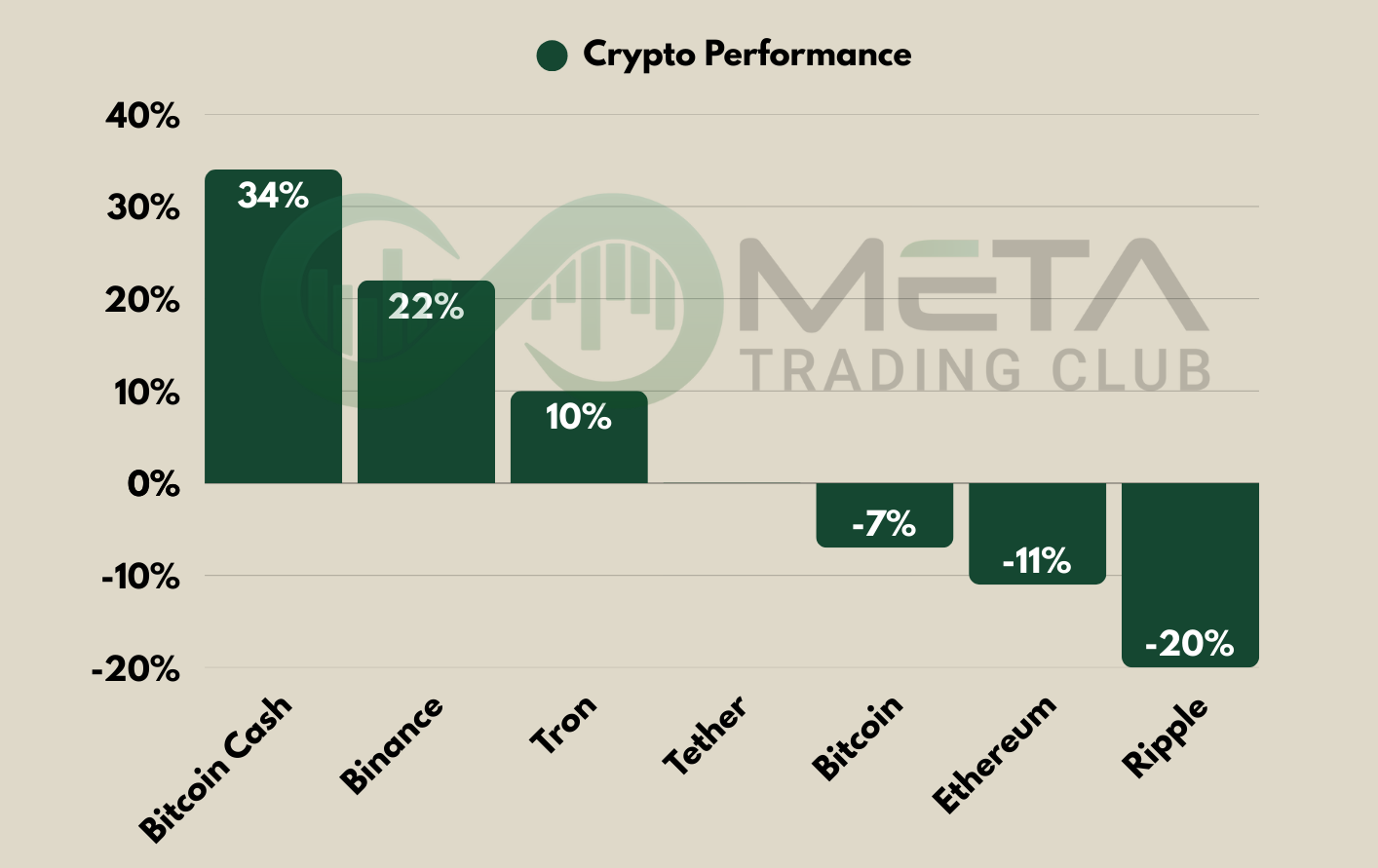
Crypto markets had a hard time in 2025 as major assets faced liquidity pressures while select altcoins benefited from ecosystem‑specific catalysts.
- Bitcoin fell 7% as tighter liquidity and regulatory pressure reduced broad risk appetite.
- Ethereum declined 11% amid rising competition from faster and cheaper Layer‑2 ecosystems.
- Bitcoin Cash rose 34% on renewed retail speculation and meaningful network upgrades.
- Binance Coin gained 22%, supported by strong exchange activity and expanding on‑chain utility.
- Tron advanced 10% as stablecoin flows and consistently high on‑chain usage strengthened its ecosystem.
Commodities Performance
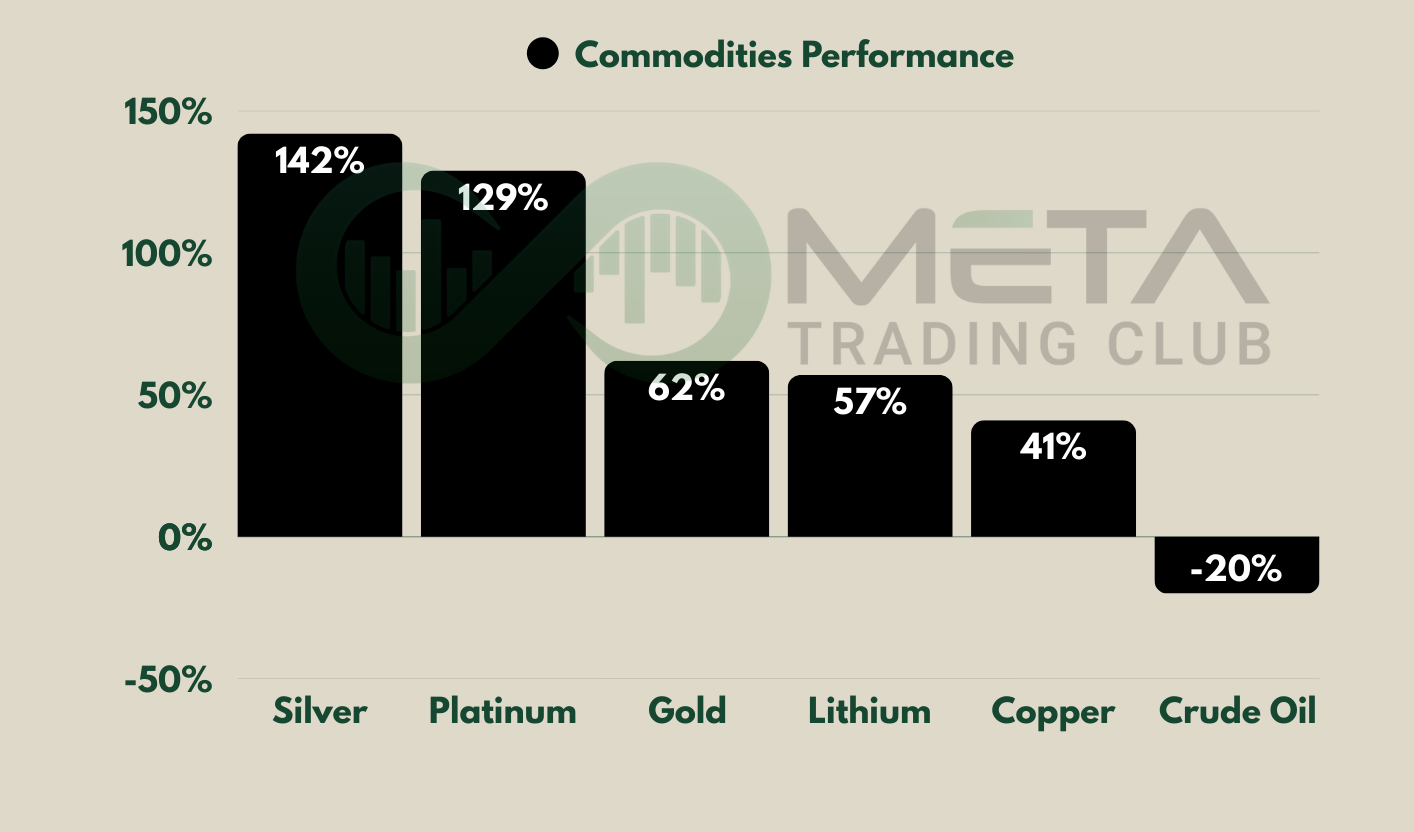
2025 was a defining year for global commodities, marked by extreme divergence between precious metals, industrial metals, and energy markets.
- Silver surged 140% as investors piled into safe‑haven assets during geopolitical tensions, while booming demand from solar, electronics, and EV manufacturing tightened already-constrained supplies.
- Gold climbed 62% on strong central‑bank buying, persistent inflation concerns, and a softer U.S. dollar, making it a preferred hedge throughout the year.
- Platinum jumped 128% due to supply disruptions in major mining regions and rising industrial use, especially as automakers substituted platinum for more expensive palladium.
- Copper rose 41% on structural demand from AI data centers, electrification, EV infrastructure, and grid upgrades, all while global inventories remained historically low.
- Crude oil fell 20% as oversupply, record U.S. production, mild weather, and weaker‑than‑expected global demand outweighed geopolitical risks and OPEC+ production cuts.
2025 Economic Indicators
The year 2024 was marked by several key economic indicators that shaped the global financial landscape:
- GDP growth accelerated from 3.1% to 4.3%, reflecting stronger consumer spending, improved business investment, and a more supportive global backdrop that helped lift overall economic momentum.
- Interest rates eased from 4.5% to 3.75%, as policymakers shifted toward a more accommodative stance in response to cooling inflation and softer labor‑market signals, providing relief to borrowers and financial markets.
- Inflation held steady at 2.7%, indicating that price pressures remained contained despite faster growth, helped by improved supply chains and moderating energy costs.
- Unemployment rate rose from 4.2% to 4.6%, suggesting that while the economy expanded, hiring slowed and labor demand softened, particularly in interest‑sensitive sectors.
- Wage growth moderated from 5.8% to 5%, pointing to easing labor‑market tightness and reduced pressure on employers, which helped stabilize inflation but signaled a shift toward a more balanced job market.
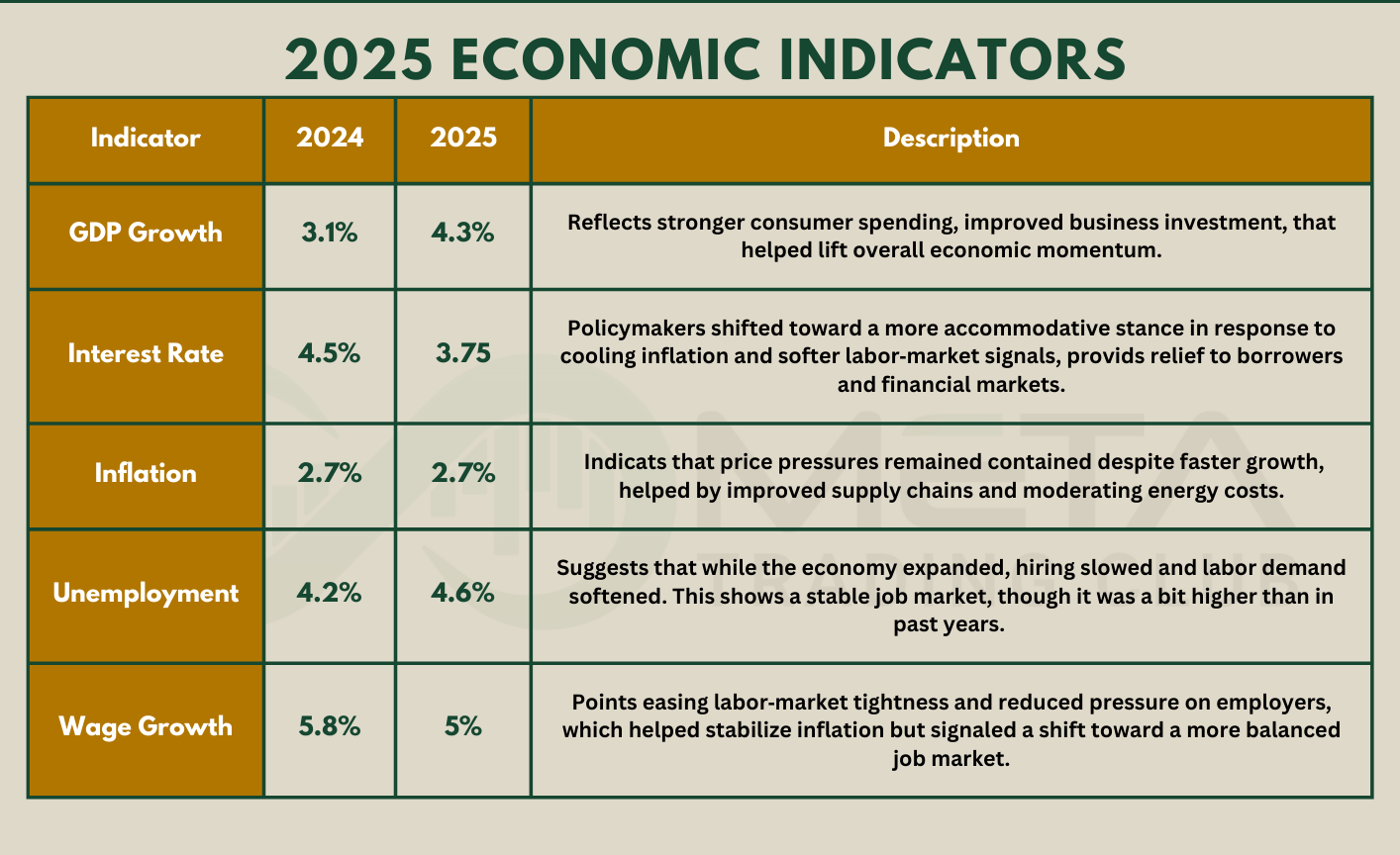
The combination of stronger GDP growth and lower interest rates suggests a more supportive economic environment heading into 2026, with policy easing helping sustain momentum. However, rising unemployment and cooling wage growth point to a softening labor market, signaling that future expansion may rely more on productivity and investment than on consumer strength.
2026 Outlook
A global GDP growth of 2.5% is forecasted for 2026. U.S. GDP is expected to grow by 2.6%. This optimism is driven by front-loaded tax cuts, easier financial conditions, and a lessening drag from tariffs. The first half of 2026 is projected to be especially strong due to a boost in tax refunds.
Despite sturdy GDP growth, the labor market is expected to remain “stagnant.” Job growth slowdown and Employment growth in developed markets have fallen below 2019 levels. This weakness is attributed largely to a sharp downturn in immigration and labor force growth, a trend most pronounced in the U.S.
Core inflation is expected to fall to levels consistent with central bank targets in 2026. Also, U.S. inflation, excluding tariffs, is already around 2.7%.
Meanwhile, central banks are expected to converge on lower interest rates. The Fed may project to cut rates by 50 basis points to a range of 3.0%–3.25%.
A key theme is China’s massive current account surplus (projected to reach 1% of global GDP). This will weigh heavily on economies that compete directly with Chinese manufacturing, specifically Germany. However, they note that China has shown a strong ability to navigate trade tensions and mitigate the impact of high tariffs through price competitiveness.
S&P 500 Technical Analysis Insights:
The S&P 500 has been trading beneath a significant Fibonacci resistance cluster, setting the stage for a potential bullish move as the RSI breaks its downtrend and signals improving momentum. A decisive rally could push the index above the 6900 resistance zone and maintain levels there. Holding above this threshold would pave the way for further upside, while slipping back below it could increase the risk of another rejection.

Personalized Guide to Independent Trading